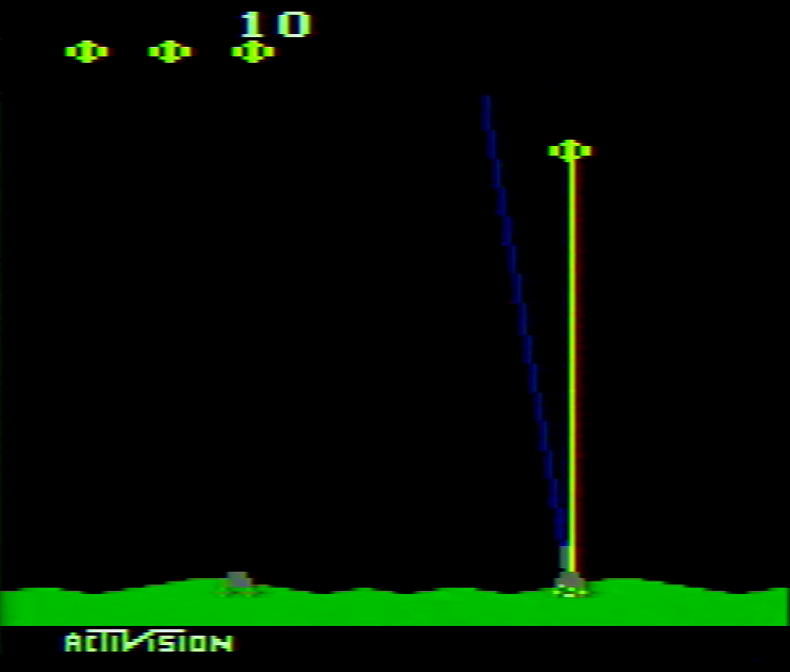
In addition to titles published by Atari and Sears, Activision had two releases in March 1981 as well. The company’s six offerings from 1980 were broadly considered to bring a new degree of graphical refinement and interesting subject matter to the VCS, and the developers at the company continued to produce inventive and impressive games in the new year. Case in point is Laser Blast, which takes the common video game premise of a space-themed shooter and flips it around, resulting in a challenge where players go on offense.
The central conceit of Laser Blast is that this time, the player is not defending themselves from enemy vessels, but rather portrays the attacker going after a planet’s defenses. You control a saucer flying around at the top of the screen, firing on defensive tanks with your laser beams while avoiding enemy potshots yourself. Each wave sees the tanks speed up their movements and their counterattack timing, and as expected, the goal is to eliminate these enemies and survive as long as possible.

Despite space-themed shooters becoming one of the dominant game genres in arcades – where Space Invaders, Galaxian, and Asteroids were all bringing in serious money and new titles like Scramble, Defender and GORF were on their way to successful runs too – very few have appeared on the VCS to this point. Rick Maurer’s Space Invaders is still the biggest game on the platform, but you’d have to go back to early releases like Star Ship and Space War to find anything similar. Even competing platforms were fairly sparse: of the big two competitors, the Intellivision only had Space Battle on store shelves, while the Odyssey2 was a little more attuned to the zeitgeist with Cosmic Conflict!, Alien Invaders – Plus! and Invaders from Hyperspace!. With this in mind, Laser Blast and its reversal of fortunes debuted at a great place and time to become a big hit for Activision – according to a 1984 interview with Activision’s CEO Jim Levy in the pages of Antic magazine, Laser Blast was one of the company’s million-plus sellers, and very likely their first one.
Laser Blast comes to us from David Crane, last seen with August 1980’s releases Fishing Derby and Dragster. The initial idea came, unsurprisingly, from the lasers that are the centerpiece of the game’s interactions. When I corresponded with Crane, he explained that he had been experimenting with the limited display capabilities of the VCS, which is designed for two player objects, two missile objects, and a ball. Crane realized that he could make a sloped vertical line using the missiles and ball by reusing them in different positions on the screen, resulting in the laser graphic. He then made a moonscape out of “gentle, rolling hills” and the enemy targets that roll along on the surface. Moving the moonscape allowed Crane to simulate moving over a planet surface, which then led to the creation of the enemy “waves” that get continually more aggressive. From there it was just a matter of tweaking the enemy AI’s timing and accuracy for each wave. That “just” is doing a lot of work in that statement, too – Crane explained that the difference between an easy game and a hard or “just right” one comes down to those kinds of tweaks. He ended up at a point where novices had enough time to dodge and react while experts could enter a sort of “zen state” and lock themselves into a particular firing rhythm that would allow them to keep going for hours. Finally, much like Activision’s Dragster and Skiing before it, Crane allows players to reset the game simply by using the controller – this, he explained, was in response to how quickly players would get killed while learning the game. He remarked that he perhaps should have disabled it past a certain point threshold, but it does help keep players hooked on making another high score attempt.

This period of fine-tuning worked out, as Laser Blast does have a very strong play loop. The enemy tanks take a moment between shots, and do a pretty good job of tracking you – to the point where if you don’t keep moving, they can pick you off within each vehicle’s horizontal firing range. But you must stop moving to actually begin firing your own laser. When you push down the joystick button, the saucer’s laser tube juts out, and during this time you can aim it left or right – or just leave it straight down. Letting go of the button will fire your beam and allow you to move again. This results in players constantly having to evaluate if they can risk firing a shot at the ground before the next laser volley comes back at them. The laser firing sequence also locks in your vertical height as well, at least for a time. While your saucer is ostensibly capable of moving vertically and horizontally, each completed wave raises the floor of how low you can fly until you’re stuck at the highest altitude possible. But when you do get shot, your ship doesn’t immediately disintegrate. Rather, it begins to fall to the ground, and you still have control over its horizontal movement, allowing you to essentially take out one of the tanks with you. You’ll still be rewarded points for doing so, and since the point values increase with each wave – from 10 points per tank in the first round to a maximum of 90 points a pop – this is nothing to scoff at. Every 1000 points will reward you with an extra saucer until you have six in reserve. To my knowledge, this is the first VCS game to provide you with bonus lives save for Circus Atari’s singular extra turn for popping all of the top row of balloons, and it’s good that it does since if you get off of your timing, you will go through them quickly.
Crane has a flair for visuals on the VCS that are on full display here – the fading laser animation and the pulsing glow of your damaged ship may not be pushing the VCS’s limitations, but they are visually striking. This same pulsing is seen in the victory cutscenes for Atari’s Championship Soccer, which came out the month before, and between that game and Laser Blast it seems to have been popularized among developers. Other titles from Activision and additional companies would use the same technique seen here in a variety of contexts for future releases on the platform. Additionally, the saucer has a nice animation of blocks shifting around the center, giving the illusion that your ship is rotating around in place like the stereotypical saucer of a 1950s alien invasion movie. This makes it feel more active than the static base seen in Atari’s Space Invaders, or even the player vessels in several arcade shooters like Galaxian or GORF.
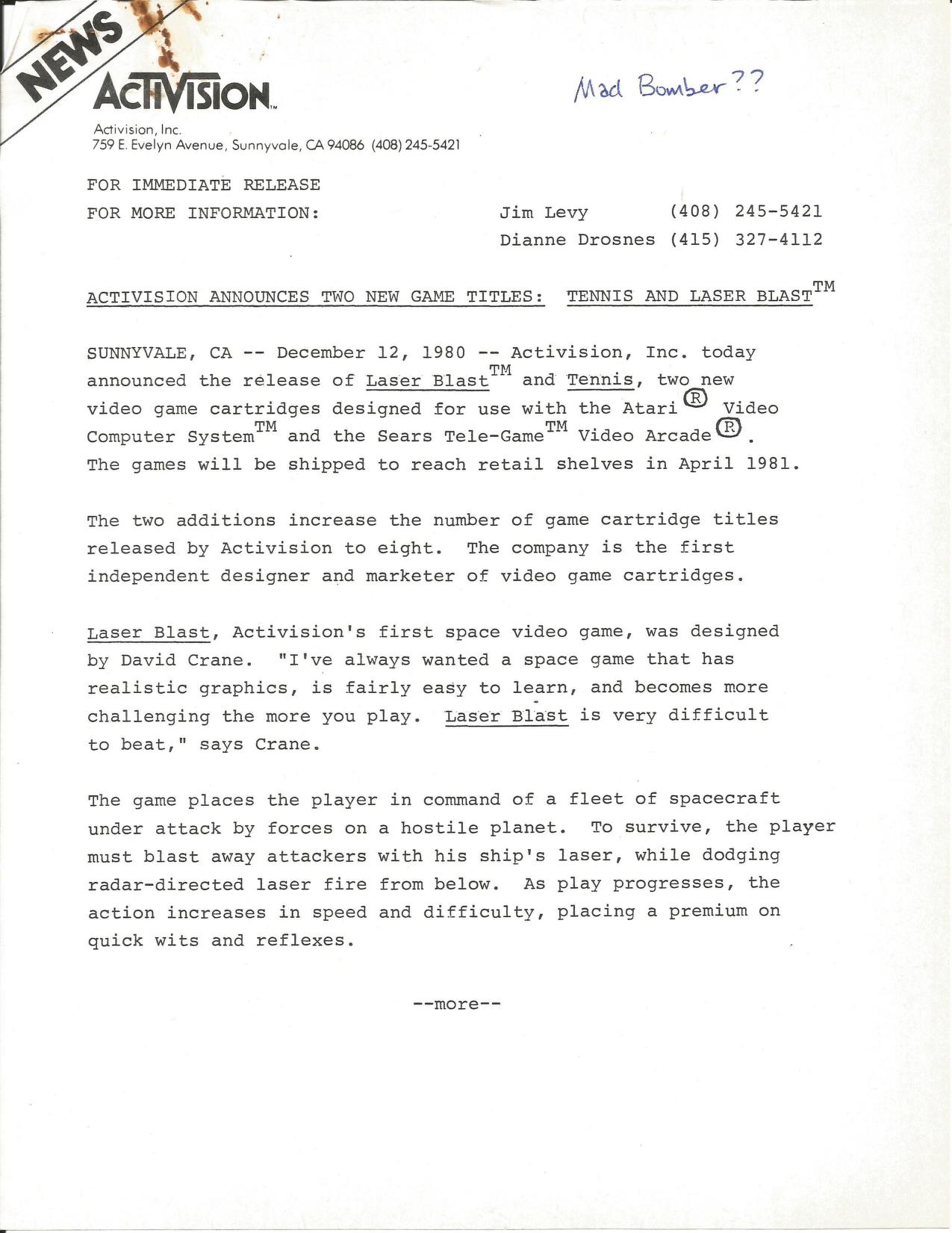
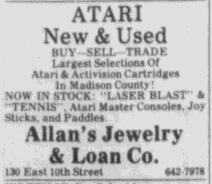
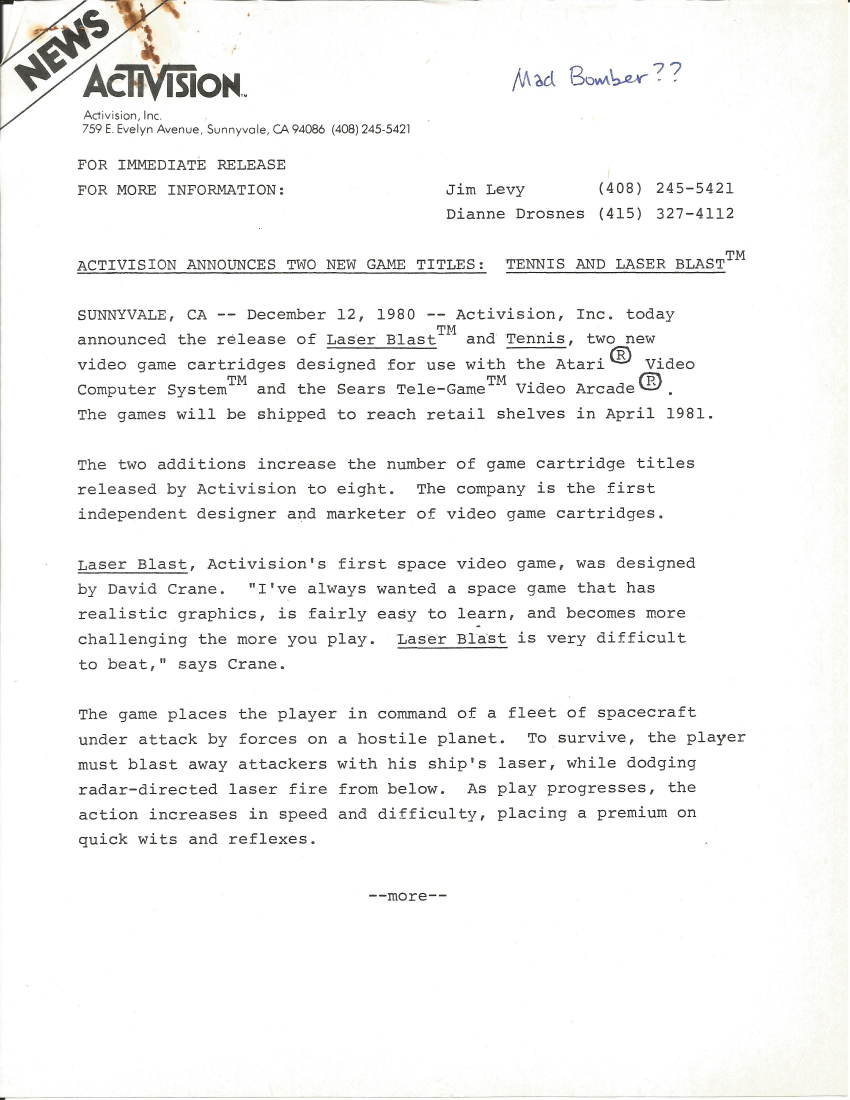
While newspaper advertising indicates Laser Blast debuted in March, a press release from Activision dated December 12, 1980 seems to have provided a more conservative April release date than what actually transpired; most likely the game began shipping in March but started making it onto shelves in some areas sooner than anticipated, similar to how things appeared to play out for Skiing and Bridge. The game seems to have been well-received, as its million-seller status would suggest. It was spoken of positively in the pages of Electronic Games and in Video‘s Arcade Alley column, where it won the runner-up spot for “best science fiction game” in the third annual Arkie Awards, and Creative Computing referred to it as one of the best space action games they saw at the Winter CES show that year. David Ahl wrote about it further in the September issue of the magazine, calling it a game of skill and endurance that none of their testing group was particularly good at. That said, he also indicates they all still had a good time playing it. There are also indications that local stores like Bambergers held Laser Blast high score competitions in 1981, capitalizing off of the game’s popularity to sell more VCS units and get people in the doors. Laser Blast would even be a game written up in early strategy guides, which broke down how to achieve 100,000- and 1-million-point games.
Achieving those scores weren’t just for personal recordkeeping, either. Much like Dragster and Skiing, sending in a photo to Activision of a score over 100,000 points would allow a player to receive a high score patch. Since the game doesn’t visually indicate the difficulty level, one could achieve this in about 25 minutes on games 3 or 4 or slog it out on the slower game 1. Activision also had a special patch made up for anyone who scores 1 million points and took a photo, too. Since the game’s score counter only has six characters, achieving 1 million points “rolls” the counter over to exclamation marks, and sure enough the patch received for these scores makes clear your achievement. At difficulty 4, this takes around 2 and a half hours and probably something other than the stock controller unless you want to destroy your wrists.
Crane relayed an anecdote from Activision about these photos, as the company’s Consumer Relations Department handled all the incoming mail – including high scores. Crane said they would receive as many as 14,000 letters a week to read and respond to, and at one point he was shown a tear-stained letter sent in from a young man who had managed to reach a million points, but his arms were so tired by the end of it that he dropped the controller, which then jostled the joystick and reset the game before he could get a photo. The letter included a note from his mother affirming that she saw him do this and asked the company to send him the patch and certificate of success, which Crane said they did. The VCS joysticks aren’t terribly comfortable over long periods of intense play with players having to hold the base while pushing the stick in varying directions, and Laser Blast is one of the games that really shows the weaknesses of its design.

Even if you’re not aiming for 1 million points, David Ahl was correct to call this a game of endurance. Once you have a rhythm and strategy down for attacking the tanks, you can zone out and keep that pace up for quite a while, though your hands will start to hurt after a while. Get knocked off your routine, however, and you’ll burn through your lives in no time. Still, this makes it a game that really would only work in the home. An arcade game needs to be constantly making money, and operators were never thrilled when one player could just sit on a machine for a long time without adding in more coins. At home, though? Crane could keep chucking in those extra lives and keep the player engaged. One normally thinks about home gaming experiences in that era as being short, arcade-style titles or more possibly complex adventures, but Laser Blast shows that there was also space for games that encourage players to take as long a time to play as they can survive.
Laser Blast also stands as something of a response to those who claim Crane never made violent games. While Crane said he thinks using extreme violence to draw attention is a design weakness, here is a title he wrote where the player is the aggressor attacking a relatively helpless planet. Even at the time this was an unusual premise with very few games taking the same approach save for obscurities such as Solar Conqueror on the Bally Professional Arcade or much later titles like the Nintendo Wii release Space Invaders Get Even.
Crane’s game is a fairly unique experience at this point in home consoles and especially on the VCS. The visuals and sound effects are as top notch as one would expect from Activision already, the play loop is very tight, and while it is repetitive, the game makes it so easy to jump back into it that it’s almost hard to resist. Its timing was perfect to become the sales hit that Jim Levy says it was, too; the VCS was riding high on the sales boom from Space Invaders by this point in time, leading to more households with a console and an interest in new games. Speculatively, Laser Blast has a similar enough premise to Space Invaders that it likely garnered some sales in its own right from more folks interested in space games. In any event, it’s a good start to 1981 for the VCS’s first third-party publisher, which had a strong lineup of classics coming the rest of the year.
Sources:
David Crane, correspondence with the author, August 2017
Activision Announces Two New Game Titles: Tennis and Laser Blast, Activision news release, Dec. 12 1980
New Games for the Atari Video Computer System, David Ahl, Creative Computing, David Ahl, September 1981
International Winter Consumer Electronics Show, David Ahl, Creative Computing, March 1981
Most Complex is Not Always Best: Simple Games for the Atari System, Bill Kunkel and Arnie Katz, Video, July 1981
Video Games: The Entertainment Revolution, Electronic Games, Winter 1981
Critic’s Choice: Best Designers’ Games, Phil Wiswell, Video Review, September 1983
Activision’s James Levy, James Capparell, ANTIC, June 1984
Conquering: Laser Blast, Videogaming Illustrated, August 1982
Laser Blast competition advertisement, The Record, June 24, 1981
The Third Annual Arcade Awards, Bill Kunkel and Arnie Katz, Video, January 1982
Starmaster Puts Player in the Cockpit, Michael Blanchet, Chicago Tribune, reprinted Buffalo Evening News May 30 1982
Release date sources:
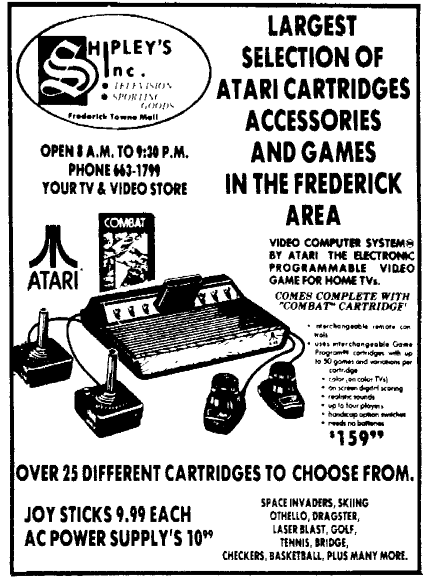
Laser Blast (March 1981): Yuma Sun, March 20 1981; The News of Frederick, March 19 1981; Anderson Daily Bulletin, March 31 1981; Chicago Tribune, April 10 1981; Activision press release, December 1980
Solar Conqueror (August 1983): Arcadian, August 16 1983; Computer Entertainer, September 1983; Arcadian, October 24 1983
Space Invaders Get Even (Aug. 26, 2008 in Japan, Dec. 1, 2008 in North America): Nintendo Life, Dec. 1, 2008