
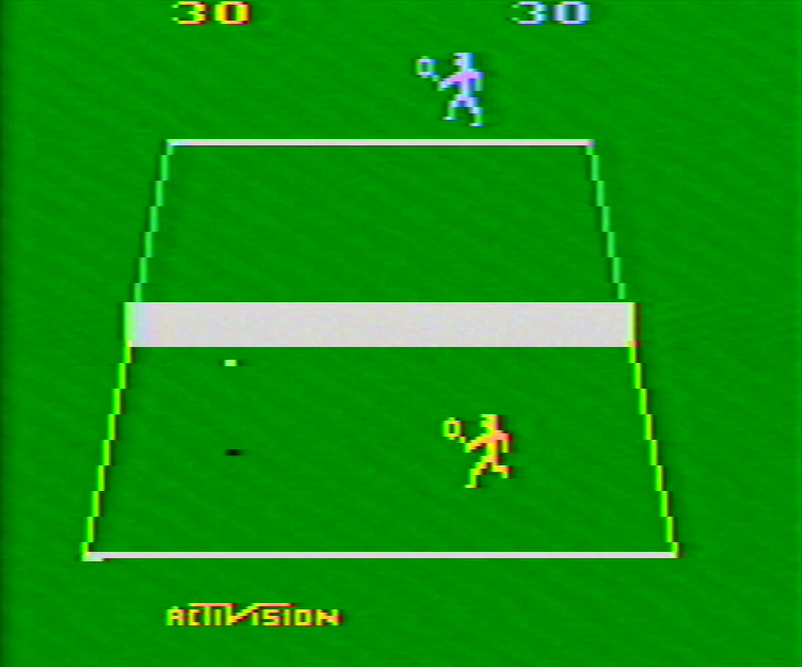
The final March 1981 release, Tennis, is another sports game from the folks at Activision, which drew attention with titles like Boxing, Skiing and Dragster in its first year. While tennis as a sport has been a standby for game-makers almost as long as video games have existed, Alan Miller’s rendition was one of the earliest attempts to make a version of the sport that was more accurate than what you’d gotten out of Pong clones the previous decade.
The obvious throughline here is, of course, Atari’s Pong itself. Pong was in turn heavily inspired – some would say a rip off, even – from the ping pong game on the Magnavox Odyssey. The Odyssey’s original game, designed by Bill Rusch in 1967, is very clearly the genesis of Atari’s arcade smash hit – the players each control a single white spot, with a smaller spot being bounced between the two. The English knob allows them to control its movements after being hit, but otherwise they have free reign over the field. The Odyssey team – consisting of Rusch, Bill Harrison and the team leader, Ralph Baer – even developed a method of using the nascent cable television technology to underlay an image of a tennis court on the screen by pointing a camera at a poster and sending it out on a bespoke channel, but despite interest from the leader in cable tv at the time, TelePrompter, this was never picked up at the time due to a recession. The released version of the Odyssey also included a “tennis” game, though really this was more a change of overlays. When Atari co-founder Nolan Bushnell came across the Odyssey during the Magnavox Profit Caravan trade show, he tasked new hire Al Alcorn with developing a simplified version to familiarize himself with the circuitry used in Atari’s arcade technology. The resulting game was fun enough that Alcorn and the other co-founder, Ted Dabney, convinced Bushnell to give it a trial run for a commercial release, and the game’s success – and Atari’s own struggle to fulfill the demand for the game – led to a slew of clones in arcades, and later in the home as technology progressed. This also led to a series of lawsuits from Magnavox and Sanders Associates, which held the patents on video game technology, including the Odyssey ping pong game… and this in turn unearthed the nearly forgotten history of an earlier tennis game.

This earlier tennis game came from a scientist named William Higinbotham, who had been involved earlier in his career on developing radar technology and the atomic bomb. Higinbotham was also a creative, and after taking a job at the Brookhaven National Laboratory, found an outlet for his energy during the lab’s annual open houses. The static displays explaining what they did were not terribly interesting to the average attendee, and Higinbotham had the idea of demonstrating their technology by getting their analog Donner Model 30 computer to play a game. Working alongside technician Robert Dvorak, the two had assembled what they called the Brookhaven Computer Tennis Game – a side view display on an oscilloscope where players used a control knob and button to set the angle of their shot before knocking the ball back over the net in real time. The game was popular upon its October 1958 debut, and returned the following year with new parameters, such as different gravity levels. Considering it fairly minor compared to his work fighting the proliferation of nuclear weapons, the game was largely forgotten until it came up during Magnavox’s legal suits. It also reentered public consciousness when Creative Computing editor David Ahl wrote about it, having serendipitously played it during its debut in 1958. Higinbotham’s game is indeed an isolated and minor part of the history of video tennis on its own, but it has developed something of a mythos surrounding it thanks to these later events under the retroactive name “Tennis for Two.” 1
By the programmable era, several of the home game systems had some spin on Pong or “tennis,” from the Channel F’s built in games to the standalone cartridges found on the RCA Studio II, the Bally Arcade, and the Atari VCS. But it wasn’t until 1981 that there were any attempts at a true tennis video game. Mattel brought its own Tennis game to market reportedly around January 1981, which reuses the side-view approach seen in Pong or even Higinbotham’s game. This is coupled with a more accurate rendition of the sport, with physical players, a court, two types of shots and actual tennis rules. But Mattel’s Tennis suffers from the side view its designers chose to work around. With this visual alignment, it proves remarkably difficult to gauge where your people are in relation to the ball, and since the players also have to manually push a button to return the ball, it ends up being pretty easy to whiff. It’s also a strictly two-player game, which means you’d have to find someone else interested enough in video tennis to give it a whirl. Activision’s game appears to have come out shortly after Mattel’s, so this seems to have been an instance of parallel development. Alan Miller took a somewhat different approach from Mattel with his VCS game, however, and fundamentally altered how tennis video games handle the sport for decades after its release.

We can glean quite a bit about the development of Tennis from contemporary interviews Miller gave – in the 1982 book Video Invaders, a 1982 issue of Electronic Games and a 1983 interview with Creative Computing. Through these sources, Miller explains that he and fellow Activision developer David Crane had been playing in the USTA Amateur Tennis tournaments since around 1978, and were both fans of the game, which led him to feel he could do a faithful rendition on the VCS, using little men and a rounded, bouncing ball. Prior to forming Activision, Miller had made Basketball for the VCS and subsequently a port for the Atari computer line; this cartridge was notable for its three-quarters perspective display, which Miller wanted to revisit. He combined the two ideas into one with Tennis, taking two weeks to create a display and then spending about three months developing the play and polishing it. Miller shifted the perspective of the game from Basketball – and indeed, earlier Pong-style games, with the two players located at the top and bottom of the screen. This is a very standard configuration for tennis video games now, but was incredibly novel at the time. This change makes Tennis much easier to play than the one on Intellivision – if the ball is out of your reach it is far easier to tell that’s the case here than in Mattel’s version.

Additionally, Miller said that he had heard feedback about Basketball from players who were having a hard time lining up their shots with the net, as it was difficult to determine exactly where the players and the ball were on the court. So for Tennis, he gave the ball a shadow that would indicate to players where, exactly, it was located on the court – something he said was pretty trivial to add, but makes all the difference in making this a legitimately good take on the sport, as it provides the illusion of depth on the court needed for the perspective to truly work. Further improving upon Basketball, Miller was able to add five different running animations and a smooth racket swing, compared to the two-frame running animation of his earlier game. The Tennis game code itself fit into 2 kilobytes of space at a time when games were routinely in the 4k cartridge size range, as Activision’s developers continued to challenge themselves to produce advanced games in as little space as possible (the fact that 2k cartridges were also cheaper to produce was likely also a factor, though not one Miller and his comrades admitted to).
Tennis follows the rules of the sport pretty closely. The players – or one player and the computer – compete to win six games and be ahead by two games wins the set. Scoring follows the traditional tennis rules of jumping from 0 to 15 to 30 and 40, with deuces taking place when both players are tied at 40 to see who gets the match point opportunity. Whoever gets past 40 points first wins the game. The ball is knocked out of bounds if it doesn’t bounce within the court boundaries before being hit, though it is counted as good as long as the opponent hits the ball. The ball can only bounce off the ground within the court one time before being counted as a point. And between games the players will switch who is serving the ball to begin with and who is on which side of the court.
Hitting the ball is done automatically once your player has gotten close enough to it, with the angle dependent on which part of the racket the ball touches. The controller’s button is used solely for serving the ball at the start of each match, though players can adjust their position to affect which way the ball will go. The difficulty switches on the VCS adjust whether or not the players can hit really wide shots that go cross-court, while the select switch adjusts if the game will be played by one or two players, and if it’ll run at full speed or half speed.

Much as in Basketball, the computer is an adept opponent here who very rarely will let the ball past it unless it’s being knocked cross-court – and if you’ve adjusted the difficulty switches to narrow the range of shots, this is made all the more difficult. Nevertheless, once a player has gotten a feel for Tennis, it is possible to overcome the computer either way. The half-speed modes are an effective way to get the hang of the game, though once you get used to it at full speed it’s difficult to go back. With two players, the game continues to be a contest over spacing. Cross-court shots are still the best way to get the ball past your opponent, and volleys can get very fast and exciting. Tennis is a fun single player experience, but with another person it proves to be a top-notch competitive game on the VCS.
Like David Crane’s Laser Blast, Activision anticipated Tennis would reach shelves for an April release but seems to have started arriving in stores towards the end of March. as indicated by newspaper ads. And also much like Laser Blast, Tennis seemed very well received, though it did not reach the sales heights or notoriety of its March brethren. The game won “best competitive game” in the 1981 Arkie Awards in the pages of Video (and Electronic Games), which describes it as far removed from Pong-style games as gasoline is from dinosaurs and as a game of aim over reflexes. It was also the runner-up for “best sports game” that same year. Bill Kunkel and Arnie Katz reviewed the game itself in the July 1981 issue of Video, gushing about the ball’s shadow, the three-dimensional perspective and the realism to its physics. They wrote about it further in the first issue of Electronic Games, dubbing it one of the best designed video games available on the market and one that could “blow your mind” if you were raised on Pong. Creative Computing gave it a short, glowing preview in its winter CES coverage before reviewing it in more depth in September. David Ahl wrote that while he never mastered it after hours of play, he had fun trying.

Of course, game development marches on, and while Miller’s take on the sport was the prime example of how Tennis could be done, eventually other developers tried to pick up the gauntlet he had thrown down. Atari published Realsports Tennis on the VCS and 5200 in April 1983, mimicking Miller’s perspective but adding some additional bells and whistles, such as a scoreboard and different kinds of shots – and on the 5200, a doubles mode that allows up to four players. On other platforms, the generally maligned Arcadia 2001 system came out alongside Grand Slam Tennis, and while this seems fairly basic even in comparison to Activision’s game, it features remarkably smooth animation. On the ColecoVision there is Tournament Tennis, a late 1984 game from Imagic that largely apes Realsports Tennis. These all play reasonably well, though interestingly the lack of automatic returns like the Activision game give these a much steeper learning curve. With the perspective being what it is, it’s easy to misjudge your shots and whiff, allowing the ball to fly right past you.
1985 saw the debut of Tennis for the NES in its New York test market – though this was also a 1984 release in another territory that simply did not show up on consoles in North America until the excess stock left from the market crash had worked through the system. This rendition was certainly not widely available at the time, which is unfortunate – the game’s speed and fidelity really makes it feel like a true successor to the Activision VCS game. Given that Activision’s Atari VCS games were not sold in Japan (at least not officially), it’s unclear if Nintendo’s designers had ever seen Alan Miller’s take directly. It’s plausible that they were exposed to the viewpoint for the sport he had pioneered from some other game, if not his. The game was well-received from the few English-language reviews that existed – Computer Entertainer praised the effects of showing the ball getting closer to the camera and the cartoonish visuals, while noting that it oddly doesn’t allow two players to go against each other or have them switch sides of the court. It’s possible Nintendo’s developers just didn’t want to deal with any potential disadvantage one player may have from the camera.
Finally, in 1986 a Europe-only Intellivision game called Championship Tennis made its way to North America courtesy of INTV, which had bought the rights to the platform from Mattel as the games market was melting down. Originally planned for the system’s ECS expansion, this version was finished by Nice Ideas in France for the standalone Intellivision console and sold in Europe in 1985 before being imported by INTV. Thankfully, Nice Ideas dropped the horizontal tennis court from the earlier Intellivision game, utilizing Miller’s vertical perspective while also adding in multiple court types, game speeds, and single, two or no-player modes. Much like the 5200 game, this also includes the option for doubles, with the computer taking over the other players on the court. Controls are otherwise much like the previous Mattel Tennis release, and while those weren’t the primary issue with that older game, here they function more or less fine. Yet Championship Tennis still retains some odd problems of its own. The hitbox on the ball is hard to figure out, and shots that look like they should connect with your racket just don’t. You effectively can really only hit the ball properly if it’s right in front of you and you swing early, which means you don’t have as much control over where you’re aiming as you’d want. Serving is also a real learning curve to get the right timing out to avoid a fault, and even the computer routinely messes it up at lower difficulty levels. In pursuit of a more realistic game experience, the Intellivision, for a second time, ends up with something that’s a bit too messy to really be recommended. Though it’s possible this is a game that just needs more time with it to really shine – Computer Entertainer praised it for giving you a lot of control over where the type of shot you make and where your ball is landing. In either case, these are problems – and in fairness, options – that Miller’s game simply doesn’t have, and I imagine someone REALLY into tennis games would consider this a much better option.
With the developments in the video tennis genre in the 40 years since Activision’s game released, Miller’s game can seem incredibly simplistic and even bare-bones. With that said, these qualities work to its advantage. Tennis is fast, exciting, and straightforward enough that even newcomers can have a blast, particularly with a partner. Much like Basketball before it, this cartridge holds up remarkably well, and is another prime example of a sports game done well on the VCS.
Sources:
Inside Gaming: Activision’s Alan Miller: Games in Perspective, Bill Kunkel, Electronic Games, July 1982
Programmable Parade, Bill Kunkel and Arnie Katz, Electronic Games, Winter 1981
Alan Miller, interview with Al Backiel, Al Backiel, Digital Press, 2003
Interview with Three Game Designers, David Ahl and Betsy Staples, Creative Computing Video & Arcade Games, Fall 1983
Video Games: The Entertainment Revolution, Electronic Games, Winter 1981
International Winter Consumer Electronics Show, David Ahl, Creative Computing, March 1981
The Inventors: David Crane and Alan Miller, Steve Bloom, Video Invaders, 1982
Designer Profiles: Alan Miller, Frank Boosman, Computer Gaming World, November 1986
Most Complex is Not Always Best: Simple Games for the Atari System, Bill Kunkel and Arnie Katz, Video, July 1981
The Third Annual Arcade Awards, Bill Kunkel and Arnie Katz, Video, January 1982
The Video Game Update: Intellivision Software, Computer Entertainer, August 1987
Videogames: In the Beginning, Ralph Baer, 2005
Who Really Invented the Video Game?, John Anderson, Creative Computing Video and Arcade Games, October 1982
William Alfred Higinbotham: Scientist, Activist, and Computer Game Pioneer, Kristen Nyitray, IEEE Annals of the History of Computing, February 2011
The Brookhaven TV-Tennis Game, William Higanbotham
The First Video Game?, Brookhaven National Labs
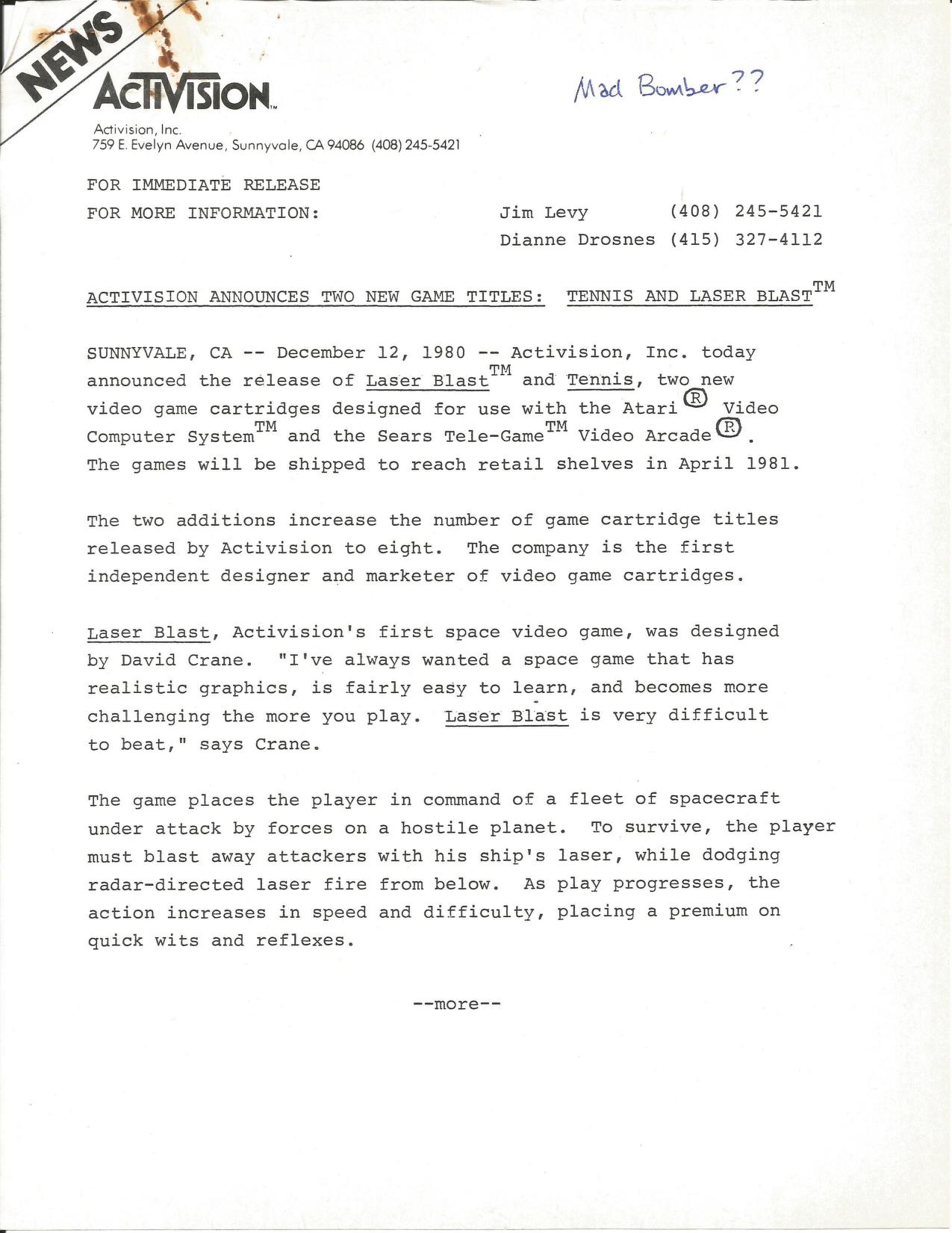
Activision Announces Two New Game Titles: Tennis and Laser Blast, Activision news release, Dec. 12 1980
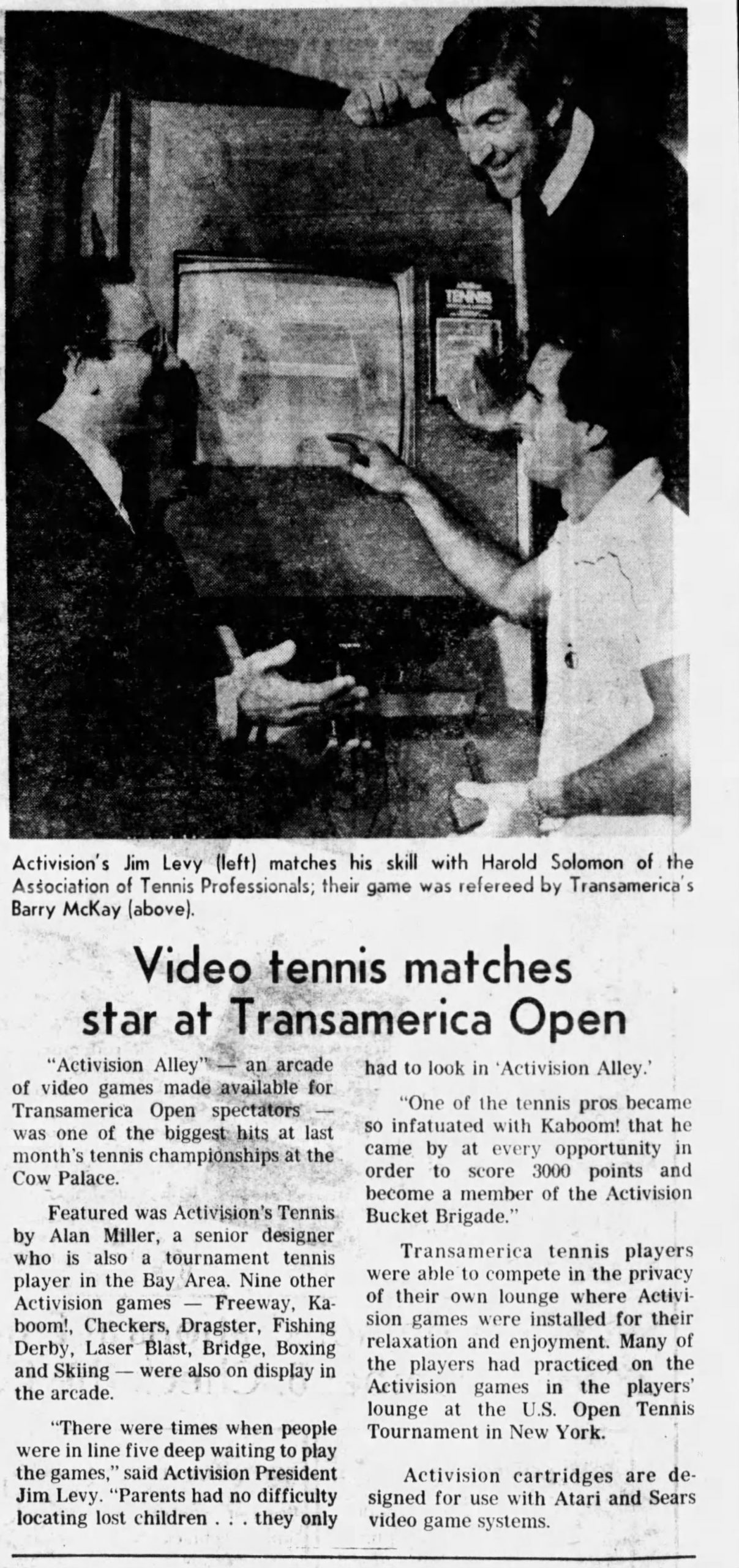
Video Tennis Matches Star at Transamerica Open, San Francisco Examiner, Oct. 25 1981
Cartridge Shipment Memo, Mattel Electronics dated Nov. 30, 1983
Championship Tennis, Blueskyrangers.com
A Superstar in the Video Games Industry, Stephen Sansweet, Wall Street Journal, reprinted in the Santa Cruz Sentinel Jan. 20 1983
Release date sources:
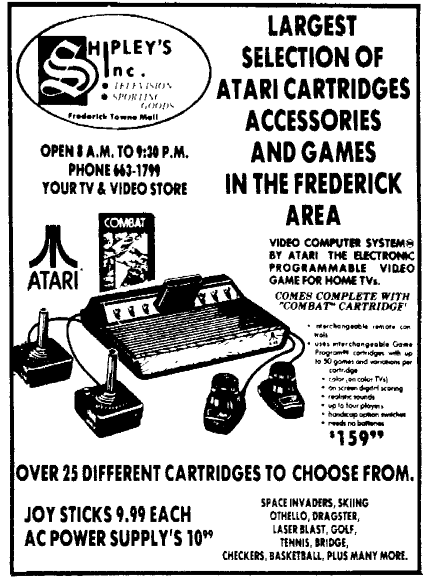
Tennis (Activision, March 1981): The News of Frederick, March 19 1981; Anderson Daily Bulletin, March 31 1981; Anderson Daily Bulletin, April 8 1981; Activision press release, December 1980; Chicago Tribune, April 10 1981; San Francisco Examiner, October 25 1981


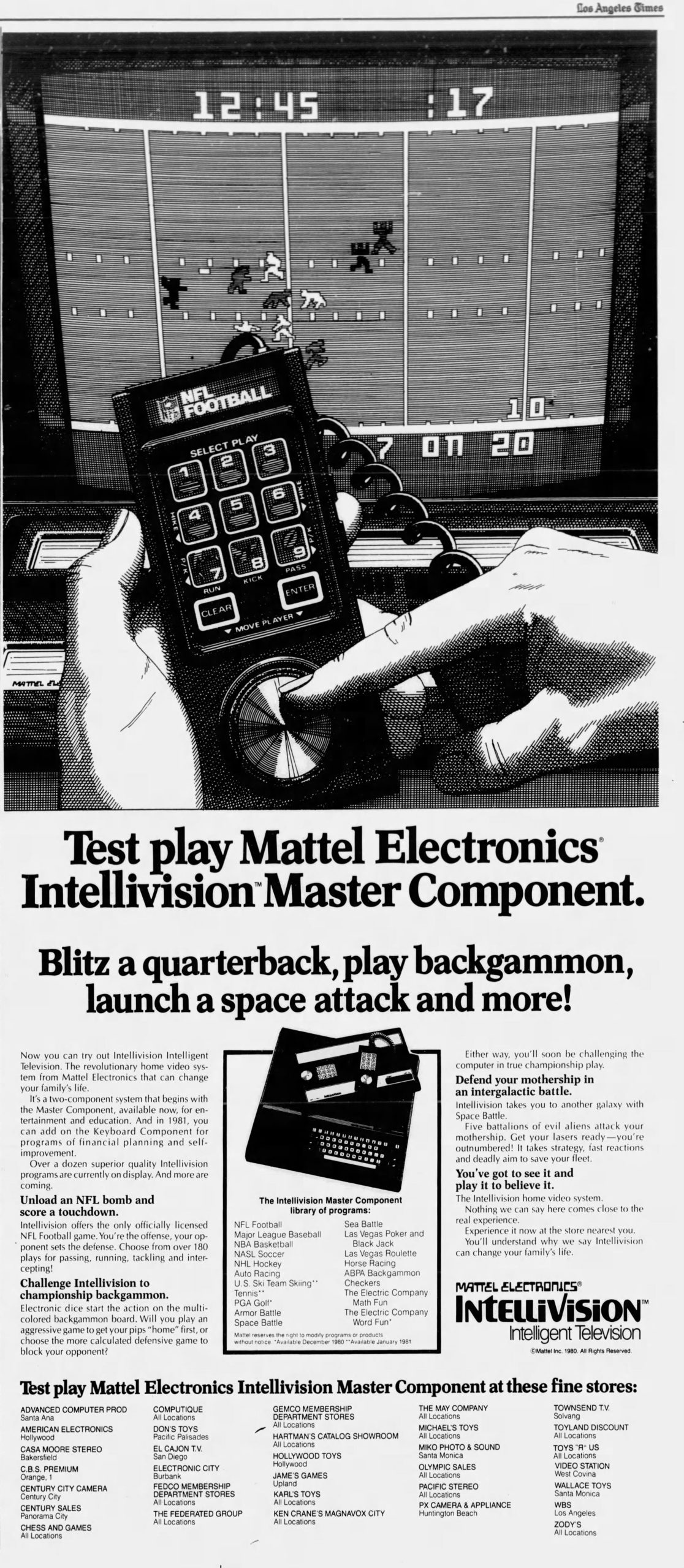
Tennis (Mattel, December 1980): Dover Times Reporter, November 27 1980; Los Angeles Times, November 9 1980;Blue Sky Rangers game list; Mattel Electronics internal sales memo, dated Nov. 23 1983

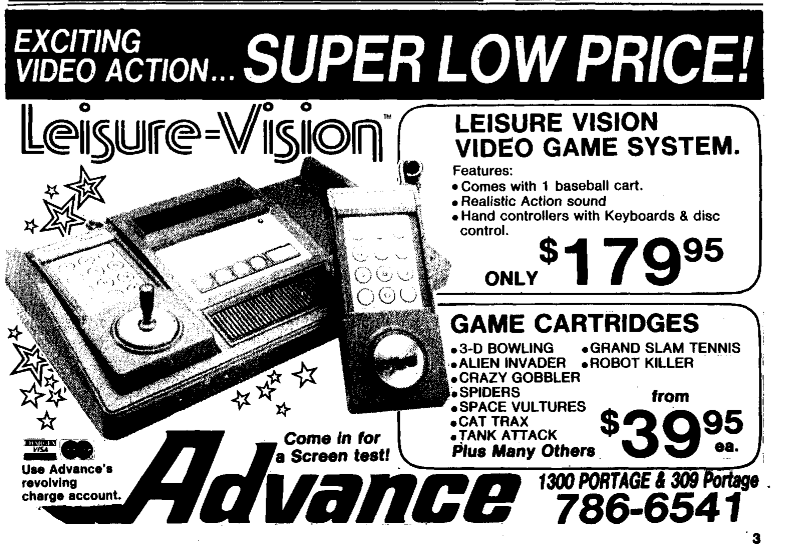
Grand Slam Tennis (Emerson, September 1982): Winnipeg Free Press, October 1 1982; Logical Gamer, October 1982
RealSports Tennis (VCS, April 1983): Computer Entertainer, May 1983
RealSports Tennis (5200, April 1983): Computer Entertainer, May 1983
Tournament Tennis (December 1984): Computer Entertainer, January 1985
Championship Tennis (1985 EU, May 1986 North America): Computer Entertainer, May 1986; Computer Entertainer, June 1986;Blue Sky Rangers game list
- No contemporary pieces refer to Computer Tennis as Tennis for Two, and the name doesn’t appear to show up until the 90s, when it was used in a 1997 Magnavox Odyssey FAQ found on Usenet. This in turn refers back to the first edition of Leonard Herman’s book Phoenix. The most likely origin is that Higinbotham’s notes about the game, written sometime in the 1980s, mentions that he designed a “tennis game for two people to play” in the second paragraph, and this was conflated as the name through a game of telephone.[↩]