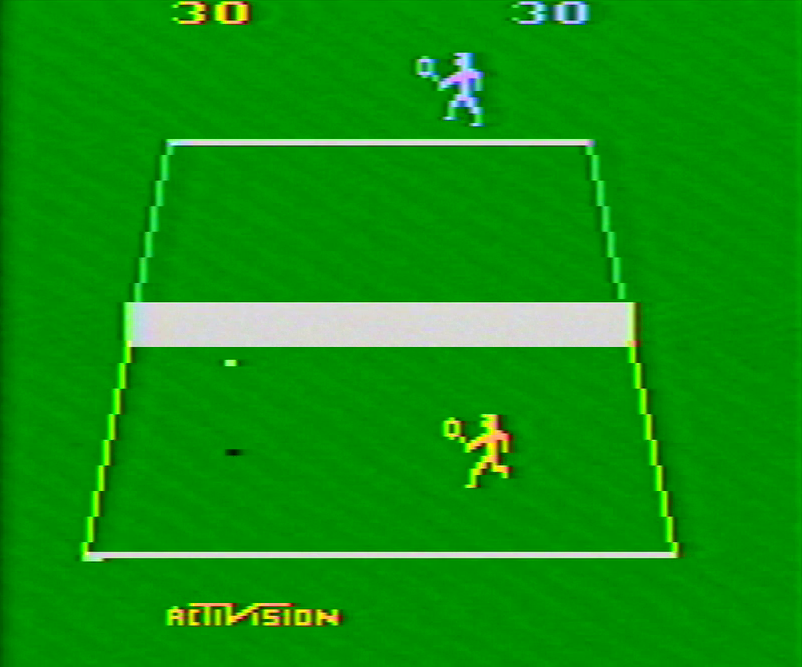
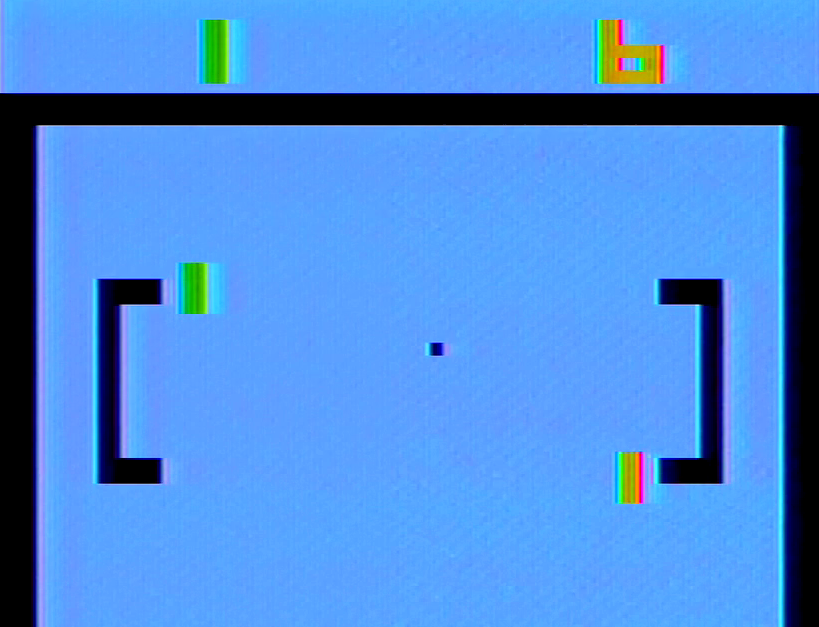
When the VCS hardware was being conceived by Jay Miner and Joe Decuir, their mission was to build a console capable of playing, at minimum, home versions of Atari’s Tank and Pong arcade games. Tank was the proof of concept game that would later be fleshed out into the pack-in title Combat by Larry Wagner, but even after hiring a group of programmers in 1976, by early 1977 nobody had taken up the task of writing a commercially viable Pong game for the system.
Of course, even by 1977 Pong was an old game concept. The arcade version launched in 1972 as the first commercial game released by Atari following the Computer Space game that Atari founder Nolan Bushnell had worked on alongside Ted Dabney. Computer Space had been published by Nutting Associates the previous year, but was considered in retrospect by Bushnell to be too hard to control for a game set up in bars and bowling alleys. Bushnell tasked early hire Al Alcorn with recreating a simplified version of the Magnavox Odyssey’s tennis game using arcade hardware as a test project, to familiarize himself with Dabney’s circuitry and their game design technology in general. Bushnell motivated Alcorn by telling him they already had a contract with General Electric to produce this game and that it had to cost less than $15 in parts. Alcorn simplified the game design from the Odyssey by eliminating the extra paddles that allowed players to move horizonally and affect the ball’s flight directly; instead, players can only move along a vertical axis, and the ball’s angle is determined entirely by where it connects with the paddles. Bushnell wanted cheering and boos as background audio, but Alcorn simply found tones that were already being generated by the game and hooked them into the speaker instead.
Continue reading “Video Olympics (Pong Sports) – September 1977” →