

March 1981 introduced a pair of novelties to the VCS library, in that they are first-party Atari games that are also retailer-exclusives. Steeplechase and Stellar Track are the first two of four games that had some kind of exclusivity to Sears, then one of the largest retailers in the United States and a partner of Atari’s in the home gaming space since it stocked Atari’s dedicated Pong console in 1975 under its own branding.
This Sears deal is rather fascinating even though we don’t have all the details on how it came about. Early in the retrogaming world, it was unclear if Atari was even involved with the creation of these cartridges, though contemporary reporting makes the linkage clearer. According to Ron Stringari, who was Atari’s vice president of marketing at the time – and who worked at Sears as a buyer before that – Sears was always in the market for exclusive products, which in gaming went as far back as their initial interest in selling Atari’s Pong as a full Sears exclusive. With the VCS rapidly becoming a huge hit in 1980, Sears opened discussions with Atari over getting some exclusive software, stuff Stringari believes was either already planned or was being thought up, with only some minor alterations being necessary – though Stringari did not remember why these specific games were chosen. One of these games, Super Breakout, was only a timed exclusive for Sears, which got to sell it from October 1981 through the Christmas season before Atari started distributing it under its own name at other stores. But the other three were true Sears exclusives and are all a little unusual in some form or another.

In the case of Steeplechase, it’s a conversion of an Atari arcade game (“developed” under its Kee Games label) by the same name about horse racing that came out nearly five-and-a-half years earlier in October 1975. Known in development under the code name Astro Turf and predating microprocessors being widely used in arcade video games in the first place, the original is a one-to-six-player game where each person competes to finish the race before everyone else, pushing their lone buttons to leap over hurdles. Corporate memos largely written by Steve Bristow and held at the Strong Museum of Play discuss the arcade game’s development: assigned to Lyle Rains as project engineer and Dave Story as technician around December 1974, an initial version was expected from Atari’s Cyan Engineering skunkworks in mid-February, but this date appears to have slipped a bit; an update memo from March indicates it had been updated to include four players and a pace horse, with the race ending once the pace horse reaches the end (and a free play for a person who manages to beat it to the finish line). For added challenge, the leading horse had a randomly longer jump. There were discussions of including some sort of musical tape element to play the starting bugle call and Camptown Races during the heat itself, and Cyan was working on a two-track tape unit that they’d hoped to have ready in time for Steeplechase‘s production deadline of July 1, but this doesn’t seem to have panned out; the final version seems to have in-built audio hardware playing the bugle call and only crowd sounds and gallops during the race. It wasn’t a big hit for Atari, which reportedly only sold around 500 cabinets, but it got a second life here on the VCS. Huether explained to me that after finishing Sky Diver, he once again chose a game off the potential project list, not realizing that Steeplechase had already been made as a coin-op product. Nevertheless, he told Scott Stilphen in a 2007 interview that he did base his work off of that earlier title. In all, Huether estimates that Steeplechase took about four or five months to complete.
Given the limitations of the VCS, Huether reduced the total number of players down to four and made it a paddle controller game. While the button on the controller is still used to jump, the paddles are used to set how high each jump will be, which proves to make the game much more skill-based and enjoyable than its predecessor. The game types allow players to decide how good the computer-controlled jockeys will be – between three difficulty levels – and whether or not the hurdles to jump will appear at uniform distances or at random ones. The difficulty switches do nothing in this particular game.

According to a 2007 interview with Huether by Scott Stilphen, while he was limited in the amount of animation frames he had to work with for the horses, Huether said what he did have proved pretty convincing, as players showed empathy for horses when they stumbled. He told me that he came up with animation frames for the horse jumping up, coming down, stumbling, and a couple running frames; the frame at the top of a jump was simply reused from one of those. He added that he received feedback from the marketing department after its release informing him that it also proved to be possibly the first VCS game as popular among girls as it was among boys, a parity that extended even into the young adult and teenager demographics. Furthermore, he was told that girls tended to name their horses even though that wasn’t a function in the game at all. He remarked that it was always exciting to watch people play Steeplechase at family gatherings, and that some of his relatives would wind up staying up half the night running races.
As a single player experience, Steeplechase is a pretty decent one. Assessing the right height to jump is fairly easy, but ensuring you time your jump appropriately given the approach speed and the height you’re targeting takes some practice to get a handle on. The computer opponents are also no slouch. While on the lowest difficulty they’re pretty easy to beat, on the “good” difficulty they will only mess up a little bit, and on the hardest they run practically perfect races, requiring you to really only surpass them by jumping at the minimum needed height for each hurdle. Functionally speaking the variations on whether or not hurdles spawn at set or random distances doesn’t seem to be as huge a factor as one would think; in either case the game tends to give you as much time to react and reset your jump height as the other. The once exception to this comes closer to the end of races. In a nice little consideration to players further behind, as the horses move to the right side of the screen they will get less time to react to incoming hurdles and thus can be more likely to be tripped up. With hurdles that appear at regular intervals you can, at the least, make high jumps to stay on your feet, but when they’re appearing randomly you have less time to prepare yourself and make your jumps.

Huether considered Steeplechase to be a lot of fun as a multiplayer game, and the first simultaneous four-player game since the 1977 launch. Even if you’re short of the game’s full four-player complement, you can put the computer on its weakest setting to render it a non-issue in races with less than a full quartet. As one final bonus, players can opt to not enter a race at all, letting the computer to run against itself. I guess it’s a nice substitute if you want to bet on horse races without actually going to the track.
On the general package front, Steeplechase is the second game to follow the new Atari manual style championed by Steve Wright and introduced with Pele’s Championship Soccer, giving each of the horses a goofy drawing, personality and background that has zero bearing on their performance in-game. It’s a cute little thing that, as noted in the soccer video, hadn’t really been done on a home console before this point and helps add a lot of flavor to games that really had few other opportunities to do so. It’s a little surprising to see even the Sears releases would follow this trend, but other than the branding and cover art Sears VCS games tend to be identical to their Atari counterparts.

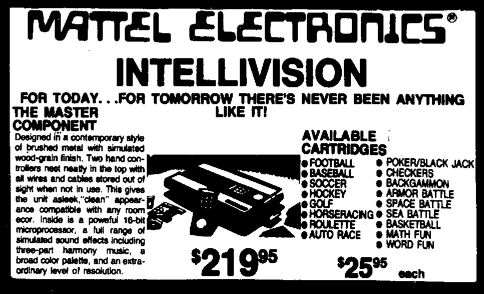
Steeplechase is something of a singular experience on a home console – while there are other horse racing games, they all had more of a gambling bent than just being pure racing. The earliest I’m aware of includes HORSRAC, a BASIC program written for the Dartmouth Time Sharing System that, according to a 1972 program catalog description, allows several players to bet and then prints out the horse positions at the conclusion of the race. Another horse racing program, simply titled Horse Race, appears in David Ahl’s 1973 book 101 BASIC Computer Games. This all said, the Intellivision game Horse Racing features both gambling and player-controlled racing. In Mattel’s title, players first place bets on the outcome of the race before taking control of up to two of the four horses running at any given time. Each horse in the race will have its own characteristics that will only become clear after multiple runs, with the game being over after 10 such races have taken place. As such, it’s ideal for people who like to analyze statistics to generate handicaps for betting. Player-controlled jockeys can either coax horses or whip them to get more speed – though since the horses have finite amounts of stamina, if they get tired out too soon they’ll drop their speed down to a trot to finish. In practice it’s actually pretty difficult to keep player-controlled horses in the lead early on, as there is more finesse to managing their energy stores than the game lets on at first. It sold rather modestly for Mattel – around 36,400 in its 1980 debut and 251,000 overall by the end of June 1983, the latest period the surviving company records have data for. Both Horse Racing and Steeplechase would be reviewed in the March 1982 edition of Electronic Games. Bill Kunkel and Arnie Katz praised Horse Racing as the best gambling game on any home console, while they called Steeplechase a modest but pleasant addition to the VCS library that offers a nice change of pace from the usual fare on the platform. They add that the height controls for jumps makes for an interesting skill separation, as while players can clear any hurdle with a high jump, the loss of speed from being airborne means better players could get ahead with lower jumps – or crash and burn from hitting the hurdles entirely.

I’d also like to mention that the Bally Professional Arcade hosted several horse racing BASIC games that appear to be based off of the Horse Race program in Ahl’s book. In these you simply place your bets and the compute runs the race for you. These are simple and are essentially rudimentary versions of what the Intellivision Horse Racing game ended up as, but they are an interesting and somewhat-accessible look at some early gaming programs. That said, there are some more elaborate attempts at these betting games for Bally BASIC. The most notable among these are likely Mike Peace’s Horse Race and its update Horse Race II, which gives players a visual element of watching the horses run. There is also the truly strange and unpublished 1983 Arcadian submission Horse Race Math, which was developed by Ohio-based math teacher Joe Peoples and tasked players with solving math problems to move their horse forward – a concept that Atari itself would attempt in 1982’s Math Grand Prix.

This would prove to be Huether’s final VCS game. While he provided some technical assistance with Bob Polaro’s Realsports Volleyball, Huether would spend the months after completing Steeplechase working on a few VCS projects that didn’t go anywhere. The first of these, a football game, was based off the Atari Football arcade game and used four blue and red squares and one circle; these could be programmed to fulfill certain roles that would change as the game was played. This was canceled after Mattel published NFL Football for the Intellivision and made his graphical choices look deeply outdated. He also told Stilphen he spent time working on a submarine game that also went nowhere and a couple Atari 400/800 animation programs called Micro Flick and Micro Movie that went unreleased during one of the periods where Atari’s management decided to downplay gaming on the computer line; in fact, he had also come up with a Cartoon Maker animation program had gotten overridden on the backup system while he was on vacation, completely killing it. He would eventually use the surviving tools from those programs on his Atari 5200 titles, including Realsports Football and the unreleased Xevious. Huether himself noted an interesting pattern to Stilphen with his titles – everything he wrote, from Flag Capture right up to Realsports Football, was designed to be played with more than one person. And sure enough, while several of these, including Steeplechase, can be played alone, it’s really the multiplayer that drives these titles and makes them worth revisiting.

But before working on the 5200, Huether tried writing a couple prototype display drivers for Atari’s unreleased pseudo-successor to the VCS, known alternately as “Super Stella,” “Sylvia,” the CX-1000 or the 3200. With no history of “next-gen” upgrades in the industry to look to at this point in time, Atari had fumbled their way into an unusual concept to move forward from just the VCS. The company proposed offering three console product lines simultaneously: a low-range one (the VCS), a high-range one (the eventual 5200, a variant of the Atari 400 computer), and a mid-range one (the Sylvia, to compete with the Intellivision). Technically speaking the Sylvia prototype featured a full 6502 microprocessor (instead of the cut-down 6507 used in the VCS), an improved version of the TIA chip found in the VCS called the STIA, a revised ANTIC chip from the 8-bit computer line called FRANTIC, a Votrax voice synthesis chip and two kilobytes of memory – a massive upgrade from the VCS’s 128 bytes. Also notable is that Sylvia would have included a read/write line on the cartridge port that would make it easier to access on-cart memory or custom ICs, and used analog joysticks. Huether said that he and fellow Atari developer Rob Zdybel were among those asked to evaluate its capabilities, and were very vocal with their conclusions that Sylvia to not be powerful enough to be considered a next-gen upgrade in hardware, particularly at a time when the Intellivision was on the market with its own clear advantages over the VCS. More damning for the project was a reproducible fatal error that another developer, Bob Smith, discovered that would cause the system to completely crash. Smith said the error seemed to be in the chip designs for the system itself, and no one seemed able or willing to track it down and figure out how to fix it, ultimately leading to the machine to be canceled. For better or worse, Atari would ultimately opt to shelve the Sylvia and focus all its efforts on what became the 5200.
Still, for Huether Steeplechase is a pretty interesting note to end his VCS run on. Like Huether’s previous games, this was an unusual choice, putting Steeplechase in the same company as the love-it-or-hate-it Flag Capture, as well as Sky Diver – itself a conversion of a minor Atari arcade game. None of these really fit neatly into the realm of common and obvious game themes, such as sports, shooters or major arcade hits, all of which have dominated Atari’s releases on the platform thus far. None of them are bad games, but they all fall into the category of gap fillers – those titles that flesh out a console library without being in the top tier of releases. Steeplechase isn’t probably the first choice for a multiplayer VCS game with a library featuring titles such as Boxing, Warlords or Combat, but it’s a perfectly decent party game – especially if you can wrangle four players for it.
Sources:
Jim Huether, interview with the author, May 14, 2023
Jim Huether, interview with Scott Stilphen, ataricompendium.com, 2007
Ron Stringari, interview with the author, Feb. 17, 2021
Bob Smith, interview with the author, Feb. 3, 2021
5200 Super Blunders and Mistakes, Atari: Business is Fun, Marty Goldberg and Curt Vendel, 2012
Realsports Football, Atariprotos.com, accessed Dec. 26 2025
Xevious, Atariprotos.com, accessed Dec. 26 2025
Horse Racing, blueskyrangers.com, accessed Dec. 18 2025
Cartridge Shipment Memo, Mattel Electronics dated Nov. 30, 1983
The Atari 5200: Super-Stella/Sylvia, atarimuseum.ctrl-alt-rees.com, accessed Dec. 18 2025
Atari SS1000 “Sylvia” thread, Atariage.com, Jan. 22 2010
All in Color for a Quarter, Keith Smith, 2016 (unpublished manuscript)
Grass Valley Projects memo, Jan. 14, 1975, Steve Bristow; Engineering Goals memo, Feb. 12, 1975, Steve Bristow; Project Review, March 24, 1975; Results of G.V. Trip of 4-25-75 memo, April 28, 1975, Steve Bristow; Pajaro Dune Conference, July 15, 1975, Steve Bristow. Corporate memos, 1974-1977, Box: 51, Folder: 5. Atari Coin-Op Division corporate records, 114.6238. Brian Sutton-Smith Library and Archives of Play at The Strong.
Magnavox v. Bally et al, Nolan Bushnell testimony, 1976
Atari internal coin-op production numbers memo, atarigames.com, dated Aug. 31 1999
New Products: Horse jumping tests reflex, eye timing, Play Meter, December 1975
Video Computer System Update, ANALOG, January-February 1981; May/June 1981
Hotline, Electronic Games, March 1982
Programmable Parade, Bill Kunkel and Arnie Katz, Electronic Games, May 1982
Catalog of Program Library in the Dartmouth Time Sharing System, Oct. 30, 1972 (available via bitsavers.org)
Horserace, 101 BASIC Computer Games, David Ahl, 1973
Psychopedia, Digital Press, March 1994
Horse Race Math submission letter, Joe Peoples, Aug. 15, 1983, ballyalley.com
Release date sources:
Steeplechase (March 1981): Kannapolis Daily Independent, March 4 1981; Owensboro Messenger-Inquirer, March 11 1981; Charlotte Observer, March 5 1981
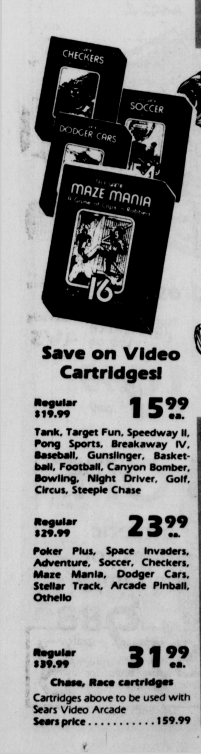
Horse Racing (Intellivision, November 1980): Santa Ana Orange County Register, November 30 1980; Frederick The News, December 3 1980;Blue Sky Rangers game list
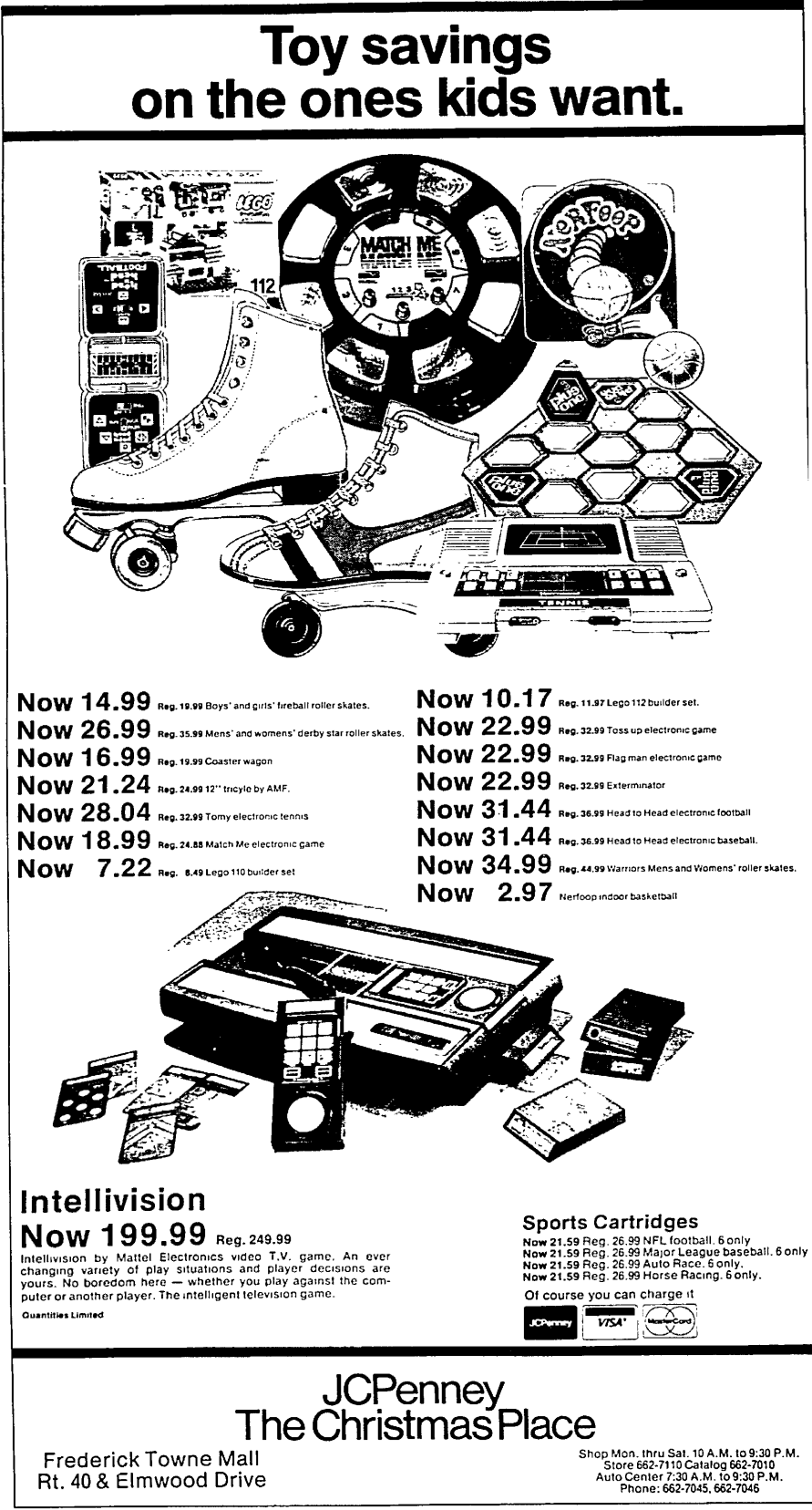
Horse Race (March 1980): Cursor, March 1980
Horse Race II (November 1982): Arcadian, November 5, 1982