

At this point in the VCS’s history, the platform has hosted a slew of traditional, real world games. Chess, checkers, backgammon, blackjack, and several others have helped fill out the VCS library with ways for enthusiasts to enjoy these games by themselves – or at the least a venue to play them without the setup. With that in mind, today’s game is practically the end of an era: Othello marks the last VCS game from Atari itself trying to translate one of these pastimes to the console. It is also incidentally the first of five games we’ll be looking at that came out in March 1981, which seems to have been the busiest month for new VCS releases that year.

Othello is a relatively recent variation of the 19th century English game reversi that was created by Goro Hasegawa in 1971. Both reversi and Othello are territory control games where players take turns placing their black or white pieces on an 8 by 8 board. Any pieces that are bounded in on two opposite sides by the opponent’s pieces are flipped to the other color, and the winner is whichever player ends the game with the majority of their pieces on the board. Hasegawa’s variant – named after the titular character from William Shakespeare’s play Othello – primarily affects the start and end state of the game. In Othello, the board opens with a square of four pieces, and ends when every possible square is filled in, with players passing their turn if necessary. This sits in contrast to reversi, which starts with an empty board and ends when a player can’t make a move. Hasegawa’s game would prove popular in Japan, and notably for our purposes became an early example of a homegrown Japanese video game. In 1978, Nintendo published an arcade version called Computer Othello; according to Florent Gorges’s History of Nintendo book, Nintendo’s president Hiroshi Yamauchi wanted a computerized version of his preferred board game, go. His engineers told him this wasn’t possible at the time, but that they could do Othello – a similar but less complex game. The game was well received in the local press, encouraging cafes to pick up units, and in 1980 Nintendo published a home conversion as a dedicated console in limited quantities. Meanwhile, In 1975 Gabriel Industries – a subsidiary of CBS – picked up the rights to sell the board game in the United States, where it was also commercially successful.
One person who was enjoying Othello around then was Ed Logg, an Atari arcade game developer who, at the time, had most recently worked on the monster hit Asteroids. After speaking with him myself, Logg said that he became fascinated by the possible strategies within the board game, and was interested in seeing if he could develop the game to be played solely by pattern matching without any kind of actual AI opponent looking ahead to devise its moves, as seen in other console strategy games. For the graphical kernel used for Othello, Carol Shaw provided Logg with the one she wrote for Video Checkers that displays a checkerboard with pieces on it; in a separate interview for the book Game Design: Theory and Practice, Logg referred to the kernel as the hard part of developing the game. Since the coin-op and consumer divisions were largely siloed at Atari and had very little crossover, Logg wrote the game in his spare time at home, working to cram his relatively uncomplicated Othello game into two kilobytes where the kernel took up three quarters of that space. Eventually, he said, his boss caught him trying to fix a bug while at work, leading to it becoming a commercial product.

Documents held by the Strong Museum of Play delve into the game’s development history even further than the comments by Shaw and Logg, however. In May 1977 Logg wrote a letter to N.J.D. Jacobs, who had written a computer reversi program mentioned in Scientific American inquiring into how that program, written in BCPL, worked under the hood, but it appears he didn’t start work on his VCS Othello game until around April 1980. By July Logg had finalized the game’s variations and how it would operate, and an undated memo indicates it market tested well. This memo notes there was some initial confusion over how the game controlled, some complaints about the color scheme, and suggestions on making the player’s turn and chip easier to pick out after a computer turn. The Othello name and ruleset needed to be licensed out from CBS for the release, and while there’s no paperwork in the Strong about this agreement, every copy of the game does have information on the label stating this.
Othello itself plays significantly quicker than the other versions of strategy games we’ve looked at in this series. This is because of how Logg had set up the computer opponent. Because it’s not thinking multiple steps ahead and thus blanking out the screen, as seen in other strategy games, the computer takes very little time to consider its moves on any of the difficulty level. While to a novice such as myself the lowest difficulty level makes for a good opponent, it is a significantly stronger player at the two higher difficulties (though reportedly is still a pushover for someone good at the game). Othello also features the usual board setup option with the left difficulty switch seen in other strategy games on the VCS, while the right switch determines whether or not the player or the computer starts the game off. In all, it’s a fine take on the board game within the limits of the VCS. Othello lacks the strategic depth of Video Chess or the numerous difficulty options in Video Checkers, but it is nevertheless no slouch. And pleasantly the game includes a two-player mode, which actually is pretty handy since then players don’t have to constantly remember to flip the pieces on the board.

Interestingly, Othello is a VCS game with two noticeably different ROM variations. In November 1980 Logg wrote a memo about changes requested by Gabriel Industries to Othello, which noted at that point in time approximately 90,000 NTSC and 20,000 PAL ROMs had been burned. Gabriel had requested that four notches be added to corners of the game board, always allowing black to move first and simply allowing players to decide if they are black or white, and adjusting how pieces are visually flipped on the board. Logg felt that implementing any of these would use up precious byte space if they wanted to keep Othello to two kilobytes, and that destroying the existing roms would prove to be a waste of money. A letter from Atari product manager Bob Gaines to Hank Kaplan, Vice President of marketing at Gabriel Industries, notes that Atari would give Logg a month to see if those changes were doable in the game code and that any such changes would only be seen in future production runs, as the existing ROMs had already been paid for.
Logg did manage to make the changes Gabriel Industries requested, adding in a few traps for the computer in the process while also making it easier to defeat on the easiest difficulty. As such, only the text label versions of Othello have Logg’s original program – all the picture label copies feature the updated game code. There have been reports online that the computer in the updated ROM is easier overall, making more mistakes mid-game than it does on the original release, but I’m not good enough at Othello to really say one way or the other if it’s true. A memo dated January 12 1981 indicates Logg had completed his changes by that date, though he himself remembers none of this process.
Earlier I called Othello the end of an era in terms of it being the final board game conversion Atari published on the VCS, but it is also the final text label release from Atari. While Sears would continue on with text labels on its carts for a while longer yet, all future releases from Atari’s own branding would have renditions of the box art on the label. Losing the text labels means that you do need to actively check the manual for information on game variations; at the same time, VCS carts going forward will not generally feature nearly the same degree of variants as those debuting in the platform’s first few years, so while it’s a little inconvenient it’s not a huge loss. These new labels certainly do make for a more visually interesting design, if less uniform.
There is unfortunately not a huge amount of information on how Othello did upon its release. We do know that between 1986 and 1988 that Atari sold just over 9,700 copies of the game, which does suggest it was a fairly minor game for the company at that late stage at the very least. A 1982 Vidiot article notes that this game was part of Atari’s “classics” line that included other titles like Video Chess and Backgammon, but no further details about the game. Othello would be bundled with Breakout and Dodge ‘Em to form the Atari Action Pak collection by March 1982, which does suggest to me that Atari did have some trouble moving units not too long into its market life.

Video Games Player gives it a generic B+ in its rating of VCS games, while the British TV Gamer magazine indicates that it’s only a challenge to new players. Bill Kunkel and Arnie Katz called its computer opponent fair, if unremarkable, in their book, the Player’s Strategy Guide to Atari VCS games. A writeup of the 1981 Toy Fair, where Atari unveiled the game, does make it sound like getting the official Othello license was a bit of a coup for the company, but unfortunately like the other games in Atari’s classics line, this one seems to have largely been ignored by the press.
While only Atari licensed the trademarked name in North America, Othello, or some variations of it, would show up on its competitors’ consoles – though there is no indication that Logg took anything from these games, or vice versa. First to market was Catena on APF’s MP1000, which was available around the same time as the system’s launch. Why the name Catena is a mystery, but it plays a pretty decent game of Othello. What makes this version interesting is that it uses the keypads on the controllers for your moves. Each square is numbered, and by entering in those numbers on the keypad, you can occupy that space – provided it’s a legal move, of course. Even when other consoles had that option, they did not take it, which is almost a shame – it’s a fairly intuitive approach taken only by APF on its minor platform.

Magnavox would also beat Atari to market with its own take, Dynasty!, by nearly two years. The main mode in Dynasty! is essentially Othello, with the four starting squares following that ruleset and the game requiring players to pass turns if they can’t make any moves. The second gametype on the cartridge, Directional Dynasty, forces players to choose which direction they wish to capture pieces in if they have the option of more than one; this does dramatically adjust the strategy needed to win in the game, and is an interesting addition to the cartridge. Unusually for Odyssey2 cartridges, Dynasty! includes a specific black-and-white option for non-color televisions. It’s unclear why more Odyssey2 games didn’t include this while this one did, but it plays reasonably well, even if the computer opponent only has one difficulty setting to work with.
Over on the Bally Professional Arcade, a type-in listing for a Bally BASIC version called O-Jello was printed up in the Arcadian newsletter on March 24, 1980. This game came from Clyde Perkins, the father in the father-and-son duo behind Perkins Engineering, which famously produced the Blue RAM memory expansion and the commensurate Blue RAM BASIC. Perkins’ game has white and black reversed, but otherwise plays a pretty good game of Othello by my admittedly low standards. In an audio introduction included with the tape release of the game, Perkins explains that he was inspired by a November 1979 BYTE article about programming strategies in reversi. Perkins’ introduction and subsequent voiced instructions even note where players can adjust the game themselves, indicating the section in particular where the computer’s strategic functionality resides. Interestingly, Astrovision – later Astrocade – announced an official Othello game for the Bally Professional Arcade shortly after securing the rights to the system in 1980, but this cartridge never came out, nor has a prototype ever surfaced. It’s unclear how much work was done on it, if any. Based on the timing it’s entirely possible that Astrovision’s personnel realized Atari had the Othello name licensed already and dropped it – or that it was simply misreported by the Cursor newsletter. Either way, Perkins’ game was certainly accessible to anyone who subscribed to the Arcadian and was willing to type in the game code, which was likely a decent subset of the Bally Arcade’s relatively small userbase at the time, or buy a cassette from Perkins himself.

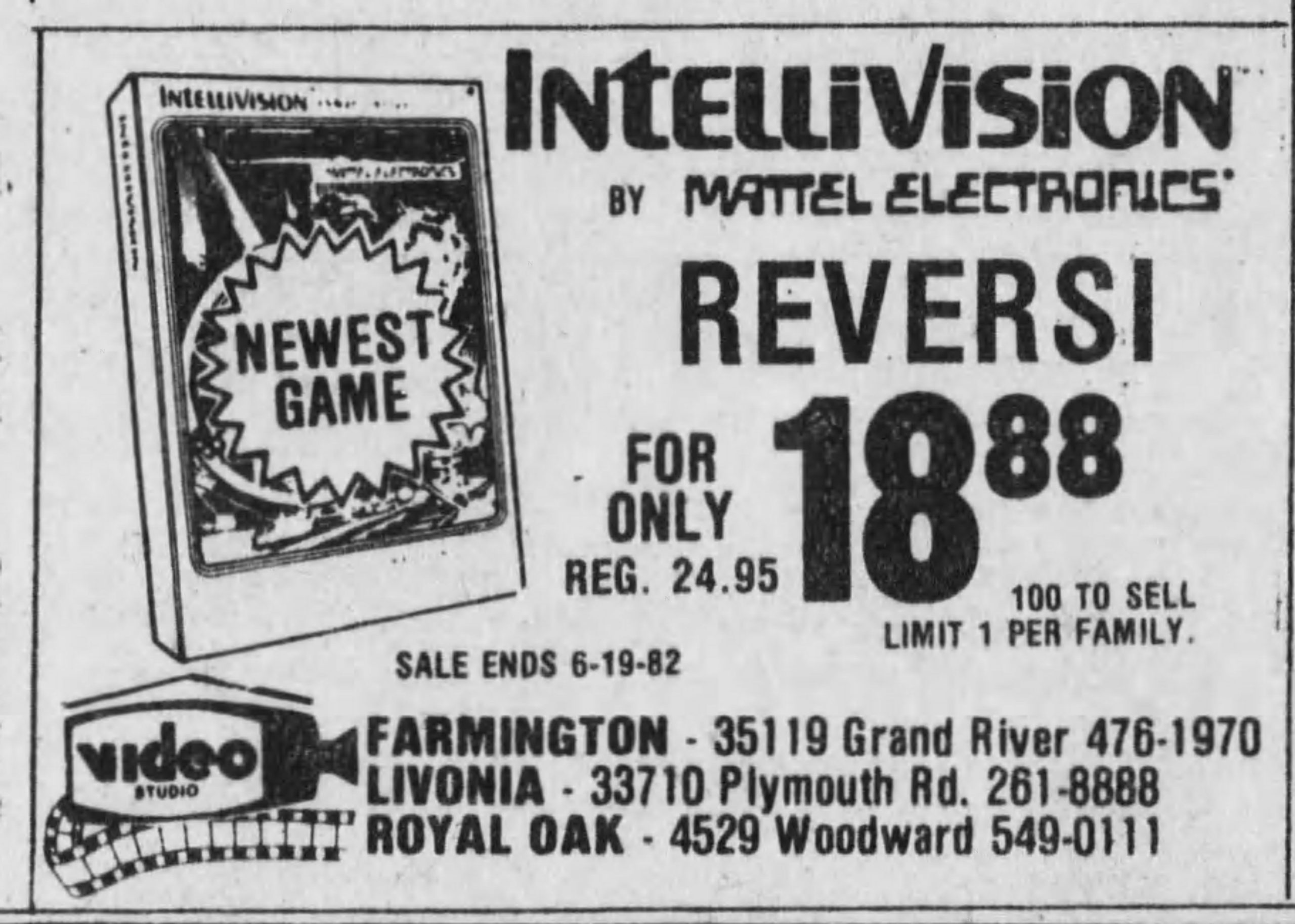
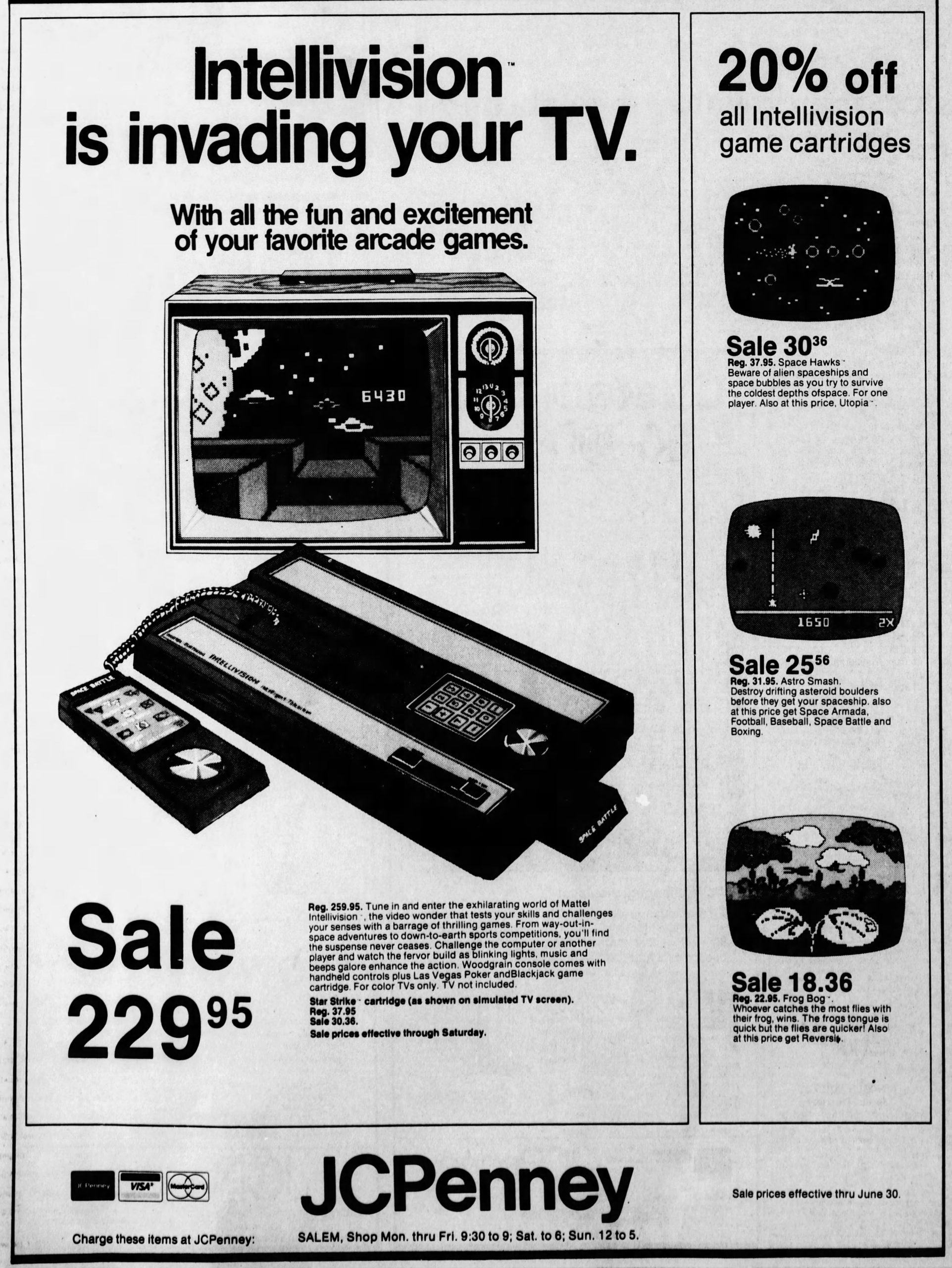
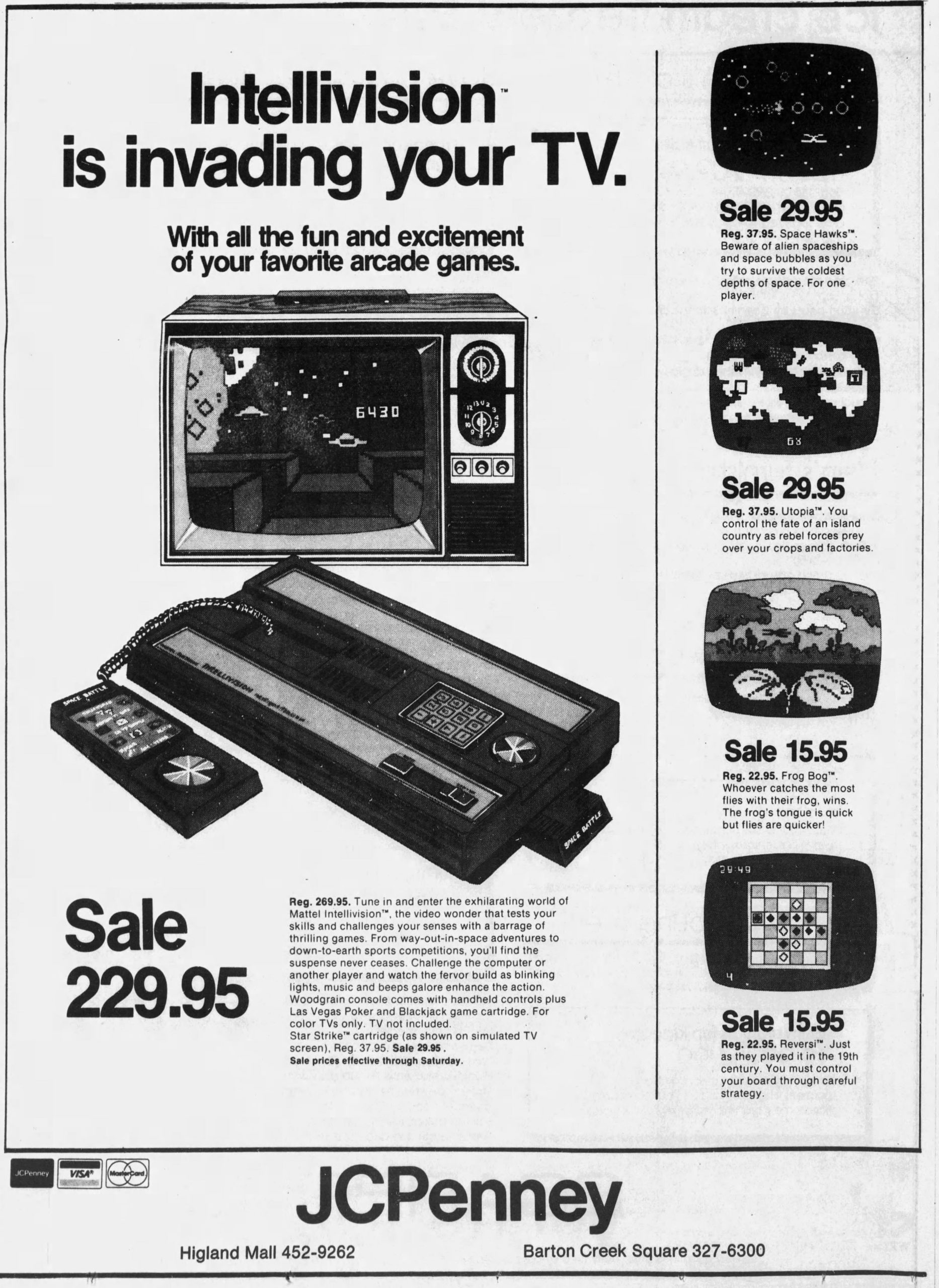
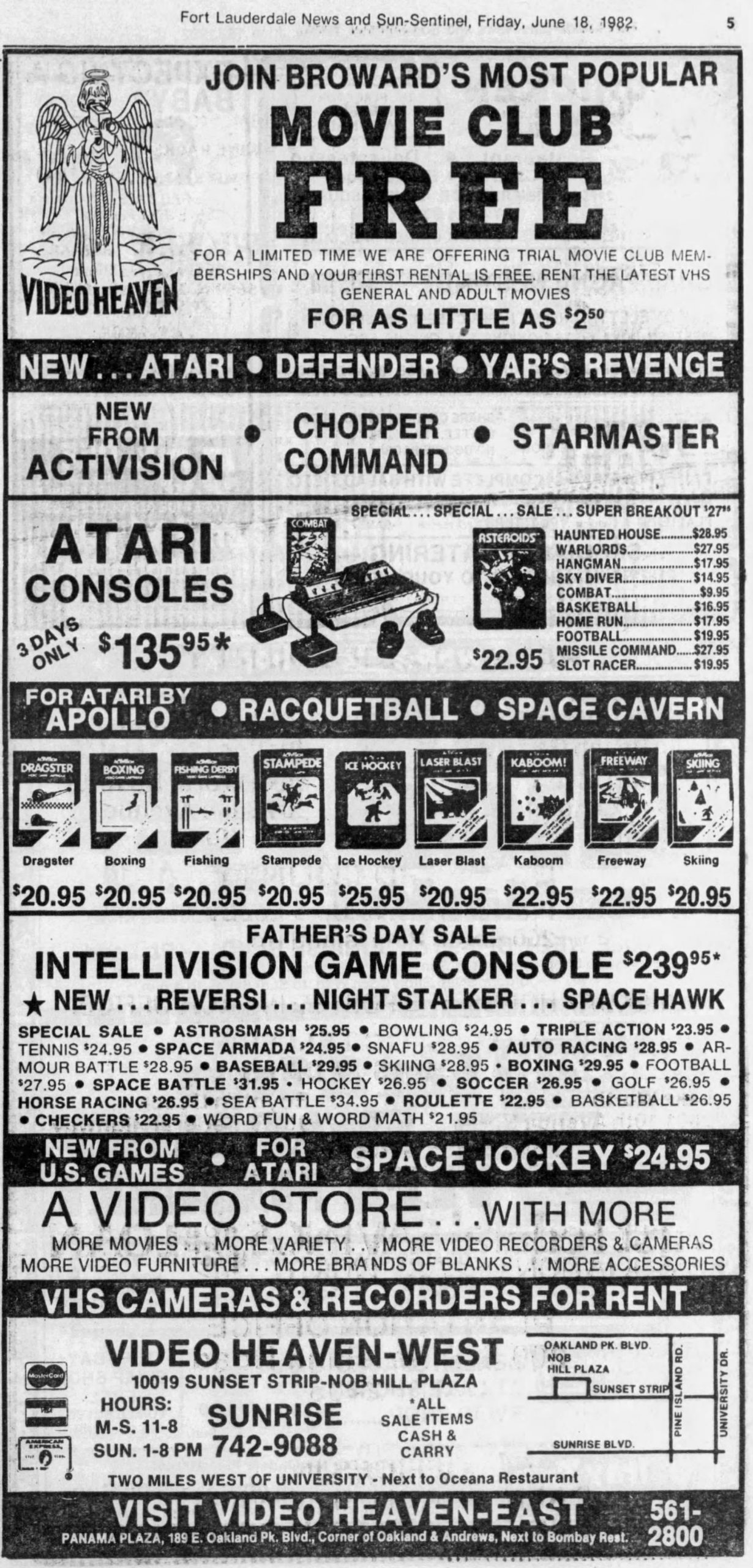
A year after Atari’s Othello cartridge came out, Mattel published Reversi for the Intellivision. Mattel’s management realized that while Atari had licensed the Othello name, reversi was public domain, and so Mattel was able to get its own version together that is essentially running on hybrid rules. While players must start the game themselves by filling in the center squares, the Intellivision conversion doesn’t simply end when one player cannot make a move; much like Othello and Dynasty!, that player passes their turn and the game continues until the board is filled in or no moves are possible from either player. Much like the Intellivision version of Checkers, this cartridge features multiple difficulty levels and includes an option to have the computer recommend moves to you, a feature that, while not perfect, seems to work better than it did in Checkers. More interestingly, the game lets you select the board size between 6x, 8×8 and 10×10. This can have a real impact on your strategy and how often you can really screw up. Finally, you have the option to choose whether or not you play as black and thus lead off the game. It’s not quite the same thing as Othello, but it is close enough, and the little fanfares that play when you win or lose are a nice touch. According to an internal Mattel document, this was not really one of their top sellers, shipping only about 88,000 units in 1982 and shipping only a few thousand more into June 1983. In contrast, most other games on the system were shipping out in the hundreds of thousands during this time. Reversi was intended to be included in the 1987 Triple Challenge cartridge sold by INTV alongside Backgammon, Chess and Checkers, but was cut at the last minute to save money.
This would be the end of the line for console Othello conversions in the US until HAL Laboratory’s Famicom conversion reached North America in 1988. In Japan, where the game was initially created, Othello appeared both on the Famicom in 1986, and on Sega’s SG-1000 in two forms. First up was the Othello Multivision, a licensed SG-1000 clone from Tsukuda Original released in 1983 that had Othello built into it. The console has a built-in SG-1000 controller, but is centered around a small keyboard with all the letters and numbers necessary to play Othello without having to move square-by-square with the joystick. Tsukuda Original had a history of producing handheld versions of Othello with similar control schemes, so the Othello Multivision appears to be part of an extended product line. This game was reworked to use standard controls as a standalone cartridge published by Sega itself in 1985, its final cartridge release for the SG-1000. Othello would even find its way to the Game Boy in 1990. And of course, over the entire time period we’ve covered here, Othello had numerous computer conversions, as it was a popular target for computer opponents like chess and checkers before it.
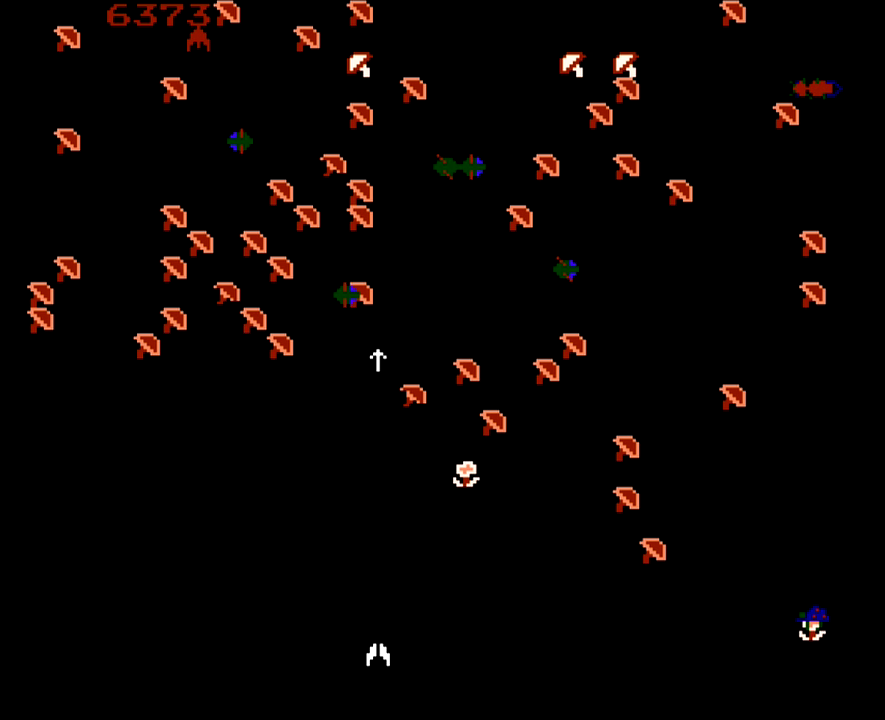
Having completed Othello, Logg would return to the realm of Atari’s coin-op programs, where he designed Centipede and its sequel Millipede and the Gauntlet games. Interestingly, Logg would also be involved with Atari Games’ forays into the NES, programming the conversion of the company’s arcade Tetris game under the Tengen label… but his history with the platform goes back even earlier than that. According to documents unearthed by Dutchman 2000 on the Atariage forum, in 1986 Atari Games had looked into working with Namco to publish a few Atari arcade games for the Famicom market, mostly to gauge if there was interest in their properties. Logg was involved in a conversion of Millipede as an animator; their program was eventually reskinned as a space game and had various enhancements made to it, such as a new super bomb weapon. Work progressed from around February 1986 into around August before work stopped. According to Logg, at that point there was a question of who actually owned the Millipede rights: in July 1984 Jack Tramiel took control of Atari’s consumer division and its assets, along with the rights of all of Atari’s arcade titles up to that point. The coin-op division continued on as Atari Games, but early on in the split it was unclear which company got which game rights. Once Atari Games discovered they didn’t have the rights to Millipede, all development halted. One build of Logg’s work-in-progress Millipede was rebuilt from a source code listing found by Atariage user Dutchman2000 on a VAX hard drive backup. With the assistance by the Video Game History Foundation in 2021, the game is playable, although it shows no signs of the space theming discussed in the documentation. In 1983, HAL Laboratories developed a version of Millipede alongside Joust, Defender II and Galaga for Atari as part of a planned arrangement between Nintendo and the American company to sell the Famicom in the United States; while Atari never released the Famicom in that region, this version was eventually published by HAL itself… but there’s no indication that Logg or anyone else on his team had seen it.
As for Othello, it’s a perfectly serviceable version of the game, though there are certainly plenty of other ways to play it today. It still remains an interesting glimpse of a time when the board game was in the zeitgeist and a popular target for computerized versions, even if it ended up as Atari’s most minor 1981 release.
Sources:
Ed Logg, correspondence with the author, April-June 2021
Interview: Ed Logg, Game Design: Theory and Practice, Richard Rouse III, 2004
Carol Shaw: Atari’s First Female Video Game Developer, Benj Edwards, Vintage Computing and Games, Oct. 12, 2011
Othello 2600 memos and notes, 1982, Box: 3, Folder: 8. Atari Coin-Op Division corporate records, 114.6238. Brian Sutton-Smith Library and Archives of Play at The Strong.
Existence of Centipede/Millipede prototypes for the NES?, Atariage.com, response by Dutchman2000 on April 20, 2020
Mathematical Games, Martin Gardner, Scientific American, April 1977
Programming Strategies in the Game of Reversi, Peter Maggs, BYTE, November 1979
Gamesmakers Exhibit New Electronic Wares, Mark Andrews, Hartford Courant, Feb. 26 1981
Gabriel’s Strategy Game Othello Now Available in Computerized, Handheld Form, Leisure Time Electronics, Spring 1981
Video Computer System Update, ANALOG, January-February 1981
Atari Software Reviews, TV Gamer, September 1983
Buyer’s Catalog of Atari VCS-Compatible Games, Player’s Strategy Guide to Atari VCS Home Games, Bill Kunkel and Arnie Katz, 1982
The Games at Home, Vidiot, October 1982
Fall 1982 Complete Home Video Game Buyer’s Guide, Sheryl Anthony, Video Games Player, Fall 1982
Reversi, blueskyrangers.com, accessed Nov. 13 2025
Atari Corp. 2600 Sales figures, 1986-1990
Cartridge Shipment Memo, Mattel Electronics dated Nov. 30, 1983
Programs in this Issue, Bob Fabris, Arcadian, March 24 1980
Dreams Come True, Fred Cornett, CURSOR, November/December 1980
O-JELLO Tape Introduction and Instructions, Clyde Perkins, ballyalley.com, 1980
Computer Othello ad, Game Machine, June 16 1978
Nintendo Computer Othello Leaflet #2, Erik Voskuil, blog.beforemario.com, Jan. 18 2013
Nintendo Computer TV Game, Erik Voskuil, blog.beforemario.com, Feb. 20 2011
Mini Nintendo Summit with Isao and Florent, Erik Voskuil, blog.beforemario.com, June 9 2013
Nintendo and Arcade Games, History of Nintendo, Florent Gorges, 2010
Othello Multivision: A Checkered History, SG-1000 Works, Jeremy Parish, 2023
Othello, SG-1000 Works, Jeremy Parish, 2023
Release date sources:
Othello (VCS, March 1981) – The Allentown Morning Call, March 7 1981; Hazleton Standard-Speaker, March 13 1981; The News of Frederick, March 19 1981
Catena (Fall 1978) – Video Buyer’s Guide, Winter 1979, Fall/Winter 1978 Montgomery Wards catalog
Dynasty! (August 1979) – Akron Beacon Journal, September 13 1979
Reversi (June 1980) – Burlington Free Press, June 9 1982; Detroit Free Press, June 12 1982; Salem Statesman Journal, June 27 1982; Austin American Statesman, July 2 1982; Anderson Daily Bulletin, June 30 1982; Winnipeg Free Press, July 2 1982; Fort Lauderdale News, June 18 1982;Blue Sky Rangers game list
O-Jello (March 1980) – Arcadian, March 24 1980
Othello (SG-1000, 1985) – Game Machine, July 15 1985, SG-1000 Works