
Atari didn’t take long to open up 1981 with a new release, as Championship Soccer – or Pele’s Championship Soccer, as it was quickly rebranded – started reaching store shelves that February. Despite being initially planned for a fall 1980 release, the first real soccer game on the VCS was seemingly delayed until after the Christmas season.
Soccer, or football for non-American viewers, was an early target for video games, given that table soccer games, or foosball, were popular arcade pastimes. Generally speaking though, early on these video arcade attempts were practically just Pong. It was relatively simple to make a version of Pong that added additional paddles on the field and possibly shrunk the goal size, and so the first arcade takes of the sport were simply Pong clones. These include Taito’s Soccer, one of the earliest video games made in Japan, and Allied Leisure’s Super Soccer. In the home, soccer was represented pretty much from the start, with an extremely primitive version on the Magnavox Odyssey; following these early arcade games later consoles featured versions more in line with their big siblings; first on dedicated machines such as the Odyssey 500, and later on to programmables through Atari’s Video Olympics cartridge in 1977. You’d be hard pressed to really consider these any kind of realistic attempt at the sport, however – they had more in common with foosball than actual soccer.

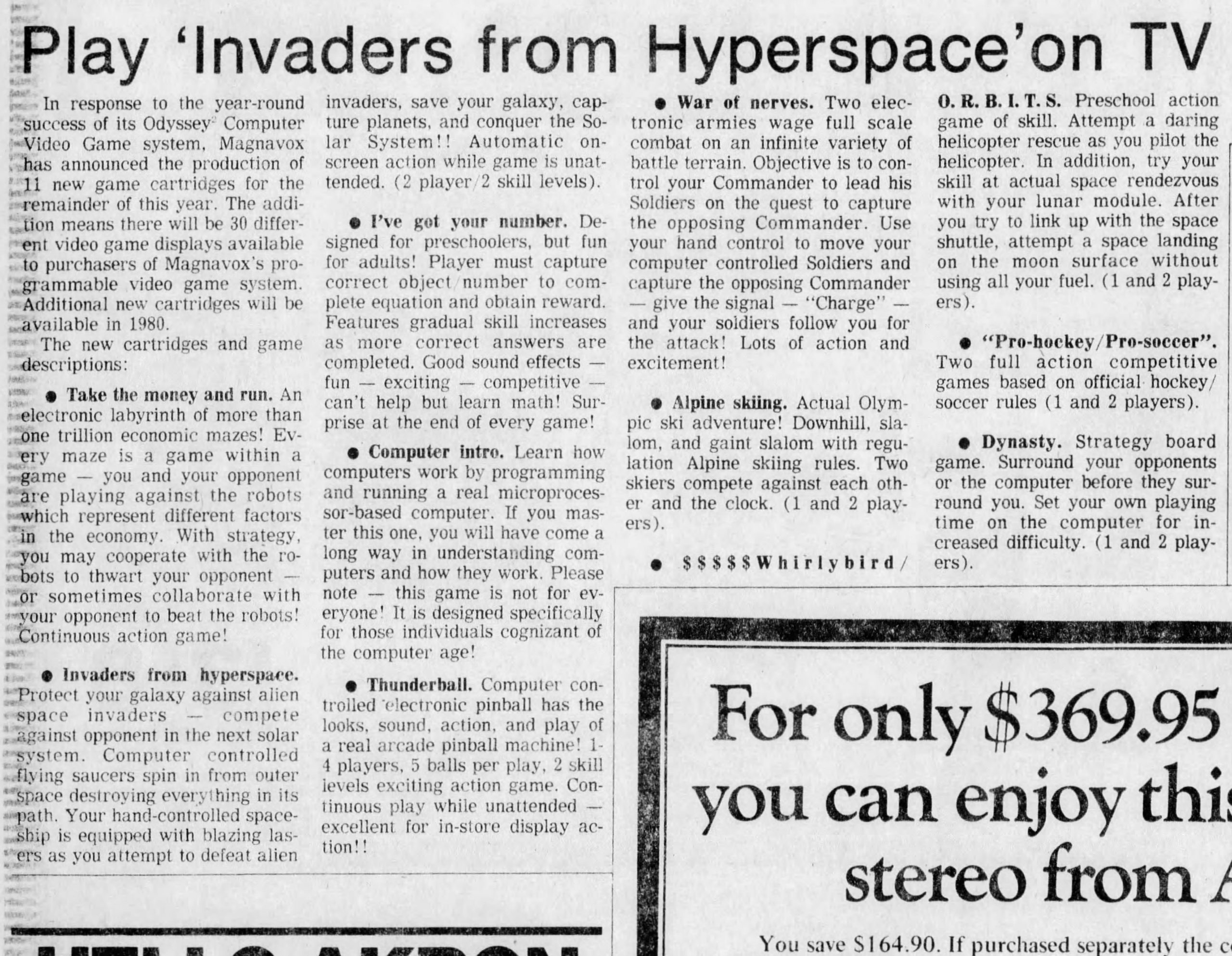
For that, you would have to wait until 1979. That year Magnavox published its Hockey!/Soccer! combination cart for its Odyssey2 game console. Not only did this game actually attempt to bring forward a proper six-on-six soccer match to a game console, but it features a few other interesting innovations over its ponglike predecessors. The human-controlled team member on the field will change based on whoever is closest to the ball, while the goalkeepers always follow the player’s movements on the joystick. Team members will do a little celebratory dance upon scoring a goal, and the ball itself has a fairly decent approximation of being kicked around the field. This all said, it’s a rather awkward game, as a poorly placed ball can cause a player to flip between characters chaotically, and it’s easy to cause characters to crash into each other and thus lock up. While it seems primitive in comparison to what other companies would have coming down the pipe, it really can’t be overstated what a sea change this little cart is in relation to its predecessors.

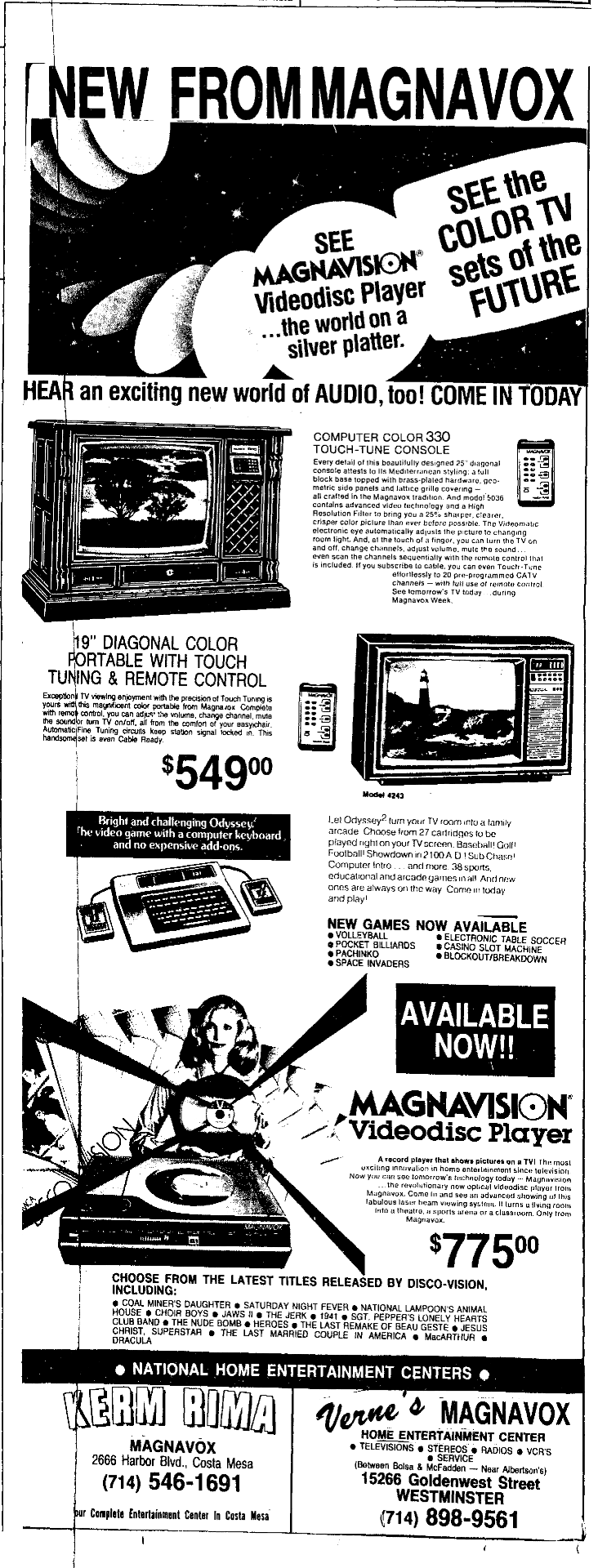
1980 would bring its own innovations from Atari and Mattel. In the arcades Atari published Atari Soccer in April, a four-player game controlled with trackballs in the vein of its successful Atari Football machines. Each player controlled a character on screen, using their kick button to send the ball flying once they’d taken possession. This doesn’t exactly approximate the nature of holding and dribbling the ball, but it got the job done (though the game failed to live up to the company’s smash hits like Asteroids and Football). Later that year Mattel published NASL Soccer for its Intellivision console, which was written by Kevin Miller of APh and separates out goalie control from player control by having them operate using the side buttons on the controller while on defense. On offense, those same buttons are used for speedy goal shots and slower passing kicks, though in either case it’s still up to the player to catch the ball. Beyond Mattel’s NFL Football release from earlier that year (which Miller also worked on), NASL Soccer is one of the earliest console games to feature horizontal scrolling, as the “camera” will pan across the field to follow the ball. This does come with some caveats, of course – much as in his football program, players on the field that scroll off on one side will suddenly reappear in the exact same position on the opposite side. This illusion of having a larger team than the system is putting on screen at a given time does work, and was specifically noted in contemporary reporting as one of the game’s strengths. While not a hot seller for Mattel, NASL Soccer did respectably well. According to an internal memo dated Nov. 30, 1983, the cartridge sold 54,200 copies in its first year, and ended the tracking period at about 284,200 copies sold. NASL Soccer won Video’s Arcade Award for best sports game in March 1981, with Magnavox’s Hockey!/Soccer! receiving a runner-up listing. Mattel would eventually bring this to the VCS in 1982 as International Soccer, which is similar but removes the goalkeepers entirely, opting instead for defense to be played by your normal players on that side of the screen. Mattel had discussed. Of all the Mattel releases for the VCS in 1982, this was the worst seller by far, shipping just shy of 53,000 units that year and wrapping at only 68,500 by June 1983 – a drop of 6,000 games from May, suggesting that this was one Mattel had seen more returns than sales of. Finally, I’d be remiss if I overlooked Magnavox’s Electronic Table Soccer cart for the Odyssey2, which attempts to bring foosball to the video game realm. It’s as much a soccer game as an actual foosball table, but it does a pretty decent job of trying to translate what was already a rather esoteric version of the sport to a game console. The computer opponent is shockingly good here… when it doesn’t get stuck in a loop.

And this brings us to Championship Soccer on the VCS. This was the VCS debut of Steve Wright, who had joined the company in September 1978 as a manager for the LSI department. His department inspected the TIA and CPU chips that went into VCS units to ensure they worked, and as the company rapidly grew Wright continually got promoted. His first stop that he remembers after LSI is the consumer division, as management felt he was a creative enough person that he could do good work in game development. Once there, Wright was asked to write a soccer game using a 4-kilobyte ROM cartridge. There was of course one small problem – Wright wasn’t a programmer and didn’t have any experience beyond teaching himself how to use BASIC. Wright sat down and learned the 6502 assembly language, only to discover there was no formal manual on how to program for the Atari VCS itself. So to familiarize himself with the VCS hardware and to have something down for posterity, Wright took it upon himself to write the VCS programming manual that would be used at Atari for years to come. Once that was completed in December 1979, he finally was able to turn his attention to writing the soccer game he was asked about when he started at Consumer.
What Wright came up with was a four-on-four take on the game where the players control a trio of soccer players, with limited control over the keeper. Their formation will automatically dribble the ball in whatever direction the joystick is pushed after coming into contact with it, while pushing the button will allow for a longer toe kick. The computer will control the keepers and try to keep them lined up with the ball, with the player influencing how quickly they move left and right with the joystick; if the keeper has the ball the player takes direct control. For variations, the game offers the option of making the sidelines rebound the ball back into play or if players will have to toss the ball back in. There are also variants for three different goal sizes and three different movement speeds, while the difficulty switches allow for one player to handicap themselves with a larger goal than usual.

With 4k of cartridge space, Wright was able to add in a few nifty bells and whistles to his game. When a goal is scored, the picture shifts to a display of fireworks going off over the stadium – something which Wright considers an early cinematic cutscene in a video game. And notably, the soccer field will scroll as players move the ball across it, with goals on the bottom and top ends and a center line in the middle. While Skiing would move trees, moguls and flags around the playfield to suggest a moving background, Championship Soccer takes this to the next level. Wright was also able to include an incredibly competent computer opponent, and fully half of the gametypes on the cartridge are specifically for single player sessions, something missing from the Intellivision and Odyssey2 soccer games and a rarity for sports games of that vintage.
The computer has three different difficulty options for single play, and they are appropriately plotted out for player skill. While a newcomer will find the novice level opponents a challenge, once you understand how Championship Soccer is played they’re fairly easy to outmaneuver. In contrast the medium and hard computer settings put up a pretty good challenge, and similar to Alan Miller’s Basketball game, the computer will get more aggressive when the player is leading and less so when it has more points.
Computer matches do not allow the ball to be kicked off the field, so penalty kicks and throws are only a thing in multiplayer matches. In these instances, the opposing team gets the opportunity to kick the ball into the field however they see fit – the team that got the penalty simply cannot touch the ball at all, though they can certainly hover around where it may end up.

Championship Soccer on the whole is an admirable attempt to do something with the sport within the limitations of the VCS, and really it succeeds. While learning how to maneuver the ball is tricky, the game does end up doing a good job of capturing the feel of battling for control in the field to get the ball where you want it to go. It does this in part by making the players always move slightly slower when they’re heading towards the opponent’s goal, so that you can never truly get a breakaway going for very long. This does make it difficult to push the ball away from your goal area, since getting it past the opponent gives them the speed advantage, but on the whole it ends up making a game that is fairly aggressive and can lead to some sizable scores by soccer standards. And this is fine, because it means you can enjoy the fireworks display more often – while it doesn’t functionally add anything to the game, it’s a welcome break given that moving across the field is almost as much of a workout on the player’s wrists as Activision’s Boxing was months prior. There is a distinct learning curve to managing your team as well. Since the three players always are a set distance apart from each other, you can get stuck in some unfortunate dead zones where only one player can reach the ball and it’s not the one you want. Similarly, reaching the end of the field means that only one side or the other of your formation is going to be against the edge, presenting problems reaching the ball and reacting to your opponents there as well. On the whole, however, the game really shows what developers had learned working on the VCS since 1977, and is real auspicious start to 1981.
Shortly after finishing Championship Soccer, Wright’s duties as the training manager of the game development department shifted to where he was in charge of more overarching home video game design decisions. This also meant he was responsible for getting game manuals written up for completed games, and as luck had it, the first manual he had to work on was for his own soccer game. The goofy backstory about this ne’er do well Atari soccer team and its players came entirely from Wright, who modeled them off of something you’d find in the pages of Mad magazine (incidentally also owned by Warner Communications at the time). Wright said this marked a change in how manuals were developed for the VCS – while most of the previous game manuals the company put out simply told you how to play the game – with some notable exceptions like Adventure – going forward game manuals will tend to be more elaborate, regularly featuring backstories and characters that are never hinted at in the games themselves. That trend within Atari would carry through for most of the VCS’s commercial life, and it all started right here with a soccer game.

Now I mentioned earlier how Championship Soccer seems to have been delayed, and a likely reason for that is Atari getting the famed Brazilian soccer player Pele to endorse the product and put his name on it. In 1975 Pele had signed to the New York Cosmos, a soccer team owned by Warner, and while he had retired in 1977 he was still an eminently bankable name for the sport. Early boxes for the game feature the original name and artwork with a small badge noting Pele’s endorsement, and later print runs would shift the artwork and the title to make the Pele connection far more pronounced. Pele himself even went on tours to promote the game, particularly in parts of the globe where soccer is a much bigger sport than the United States. Despite the implication that one of the players is supposed to be Pele, though, the manual’s text did not change. Nevertheless, it seems likely, though not for certain, that the game was delayed a couple months to ensure the packaging received modifications to make the game a bit more bankable. None of this branding applied to the Sears version, which went out simply as Soccer. Pele’s name on the game does mark this as one of the earliest examples of a video game license featuring a specific person – in this case a sports star.
Championship Soccer appears quite well received. In Creative Computing’s roundup of VCS software from September 1981, David Ahl writes that while it is complex, once the game is learned, it’s “surprisingly realistic” and tremendous fun, with enough variety within the cart to hold interest for a long time. In Electronic Games the title was the runner up for its “best sports game” in the 1982 Arcade Awards, where they consider it successful in carrying through the feel and the fun of soccer in an easy-to-understand way. Bill Kunkel and Arnie Katz also praised the game in a feature about summer sports games in their July 1982 issue, noting that the number of game variations provides all manner of options to deal with players of varying skill levels. Of course, the game featured into Mattel’s Intellivision ads where they compare it directly to NASL Soccer, which is certainly not a great look for Atari’s title, but it does appear that for VCS owners it was fine enough for 1981.
Aside from Championship Soccer and International Soccer, the VCS would also see one more take on the sport, 1983’s Realsports Soccer. This game is a more realistic attempt to translate soccer to the VCS than its arcade-y predecessor, but ultimately ends up making some of the same design choices as Mattel’s VCS game did, such as removing goalkeepers entirely and having characters reappear on the other end of the screen when scrolled off. Another take on Realsports Soccer for Atari’s 5200 game console fares much better in this regard, even including a computer opponent and trackball support, but the 5200 is also a much more capable machine than Atari’s aging workhorse. Nevertheless, Atari seemed to recognize that their older VCS soccer game still had an audience – it remained in circulation through 1988 alongside its Realsports brethren, with just over 48,000 copies sold between 1986 and 88.

The Intellivision and the Bally Professional Arcade platforms in the US saw a couple more takes on soccer in the mid-80s that bear mentioning here, both of which had been started prior to the North American crash. The Intellivision saw World Cup Soccer debut in 1986 in North America, after coming out the previous year in Europe. Essentially, this is a reworked version of a canceled 1-4 player soccer game for the Intellivision ECS add-on that was developed by Nice Ideas, formerly Mattel Electronics’ French development office, as Super NASL Soccer. After spinning off from Mattel, Nice Ideas completed the game for the standard Intellivision and published it through Dextell in Europe. World Cup Soccer, in turn, was built off of the code base of Mattel’s NASL Soccer, a fairly standard approach for late-era Intellivision sports titles. World Cup Soccer expands on that game with a brutally good opponent built into a new single-player mode, and refinements to the graphics and speed of the digital sport. After picking up the Intellivision rights and beginning to publish new games for the platform, INTV Corporation negotiated the US publishing rights for it and another game, Championship Tennis, releasing them both in May 1986. Unsurprisingly World Cup Soccer plays a lot like its predecessor with some new additions such as tackling and heading the ball, and having a computer opponent does make it a solid choice for someone interested in checking out the sport on the Intellivision today.

1986 also saw the debut, after a fashion, of a Bally Professional Arcade Soccer game that had been in development under Astrocade in 1982 but would never come out prior to the company’s bankruptcy. An early prototype of the game had found its way into enthusiast Clyde Perkins’ hands, and in 1985 another fan of the platform, Mike White, had copies produced and sold through mail order in the Arcadian newsletter; unbeknownst to him a local hobby store called ABC Hobbycraft had gotten a hold of a finished revision (who exactly completed the game is unknown) and sold copies until 1986. Once White became aware of this, started selling the later revisions as well and even offered a trade-in for anyone who had gotten the original; he estimated around 20 were sold before the newer revision took over. This title is based off the arcade game Dribbling, and despite being a little buggy and having issues with random restarts, the latest version ultimately sold gives you a lot of options to work with. The game allows play with one to four players, four difficulty levels for the computer, different rules for hitting the ball out of bounds, and to what degree players want to use the Bally Arcade’s controller knob to aim the ball. The cart even features a shoot-out mode where players take turns taking shots on goal. Herb Matthews writing in the Arcadian considered it one of the most refined games available on the platform despite its status, with a significant degree of control of the ball. It’s a robust little package, and it is unfortunate that this arcade-style take on soccer never got a mass-market release – it really gives Atari’s game a run for its money.
Not long after Championship Soccer’s release, Steve Wright would be promoted to the full director of software development, though only lasted a few months in the role before being made director of special products around September 1981. He would not personally work on any additional VCS games, but in his new role he did contribute to some licensed games Atari would produce in the coming years; Wright was responsible for getting one of the musicians behind the Charlie Brown TV specials, Ed Bogas, to do music for the Snoopy & The Red Baron VCS game, and was a major point of contact with Children’s Television Workshop throughout the development of the Sesame Street series of VCS titles. He also was notably in charge of the games department when news of Adventure’s hidden message first reached Atari, and Wright coined the term “easter egg” in reference to the secret while encouraging other VCS developers to sneak their own secrets into their games as a way to keep players interested. Wright would go on to do work for Warner’s Superman III movie, creating a video game sequence for the film that was ultimately cut from the theatrical run. After that, and with Atari struggling during the North American console market crash, Wright left the company to work for Sega in its San Diego office space, as parent company Gulf & Western wanted to more closely align Sega’s arcade business with Paramount’s film properties and use them to make new arcade games. Not long after his move the arcade business at large suffered from a sizable contraction, with Gulf & Western selling off Sega’s US facilities to Bally and Sega itself to Japanese business conglomerate CSK in 1984. With Wright now in Los Angeles without a job after that failed Paramount effort, he ended up on a career path not in video games but rather with the film industry, which he continues to work in to this day. Nevertheless Wright left his mark on game development – wherever a game has an otherwise unexplained backstory in a manual, a sports personality’s name on the box, a little flourish for your accomplishments or just some easter eggs, they can trace it right back here to Wright and Championship Soccer.
Sources:
Steve Wright, interview with the author, Sept. 25 2019
Ed Bogas, interview with the author, April 9 2021
Atari Corp. 2600 Sales figures, 1986-1990
New Games for the Atari Video Computer System, David Ahl, Creative Computing, September 1981
Most Complex is not Always Best: Simple Games for the Atari System, Bill Kunkel and Arnie Katz, Video, July 1981
The 1981 Game Awards: The Best of a Great Year, Bill Kunkel and Arnie Katz, Video, March 1981
The 1982 Arcade Awards, Bill Kunkel and Arnie Katz, Electronic Games, March 1982
Soccer Overview, Herb Matthews, Arcadian, Dec. 20 1985

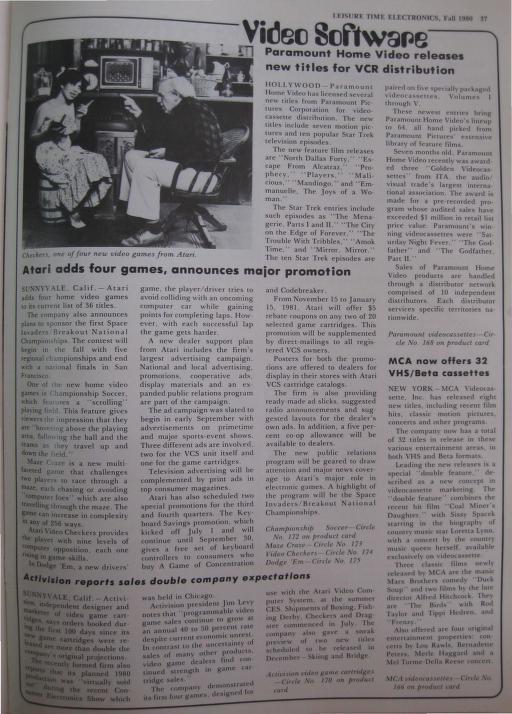
Atari Adds Four Games, Announces Major Promotion, Leisure Time Electronics, Fall 1980
Pele to Tour Europe on Behalf of Atari, Toy & Hobby World, April 1981
Why Ad Agencies are Turning Away from Print, Bernice Kanner, New York Daily News, Nov. 21 1980

Astrocade Unveils Soccer/Dribbling Video Game Cartridge at CES, press release, June 6 1982

New Games Join Home Video Craze, Shreveport Journal, Nov. 19 1980

Cartridge Shipment Memo, Mattel Electronics dated Nov. 30, 1983
World Cup Soccer, blueskyrangers.com
Astrocade Cart and Hardware FAQ, Paul Thacker, Adam Trionfo and Mike White, ballyalley.com, updated Oct. 4 2025
Atari internal coin-op production numbers memo, atarigames.com, dated Aug. 31 1999
Release date sources:
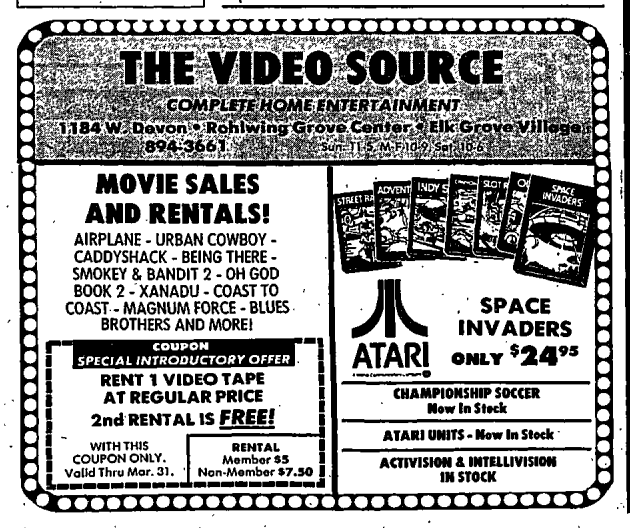
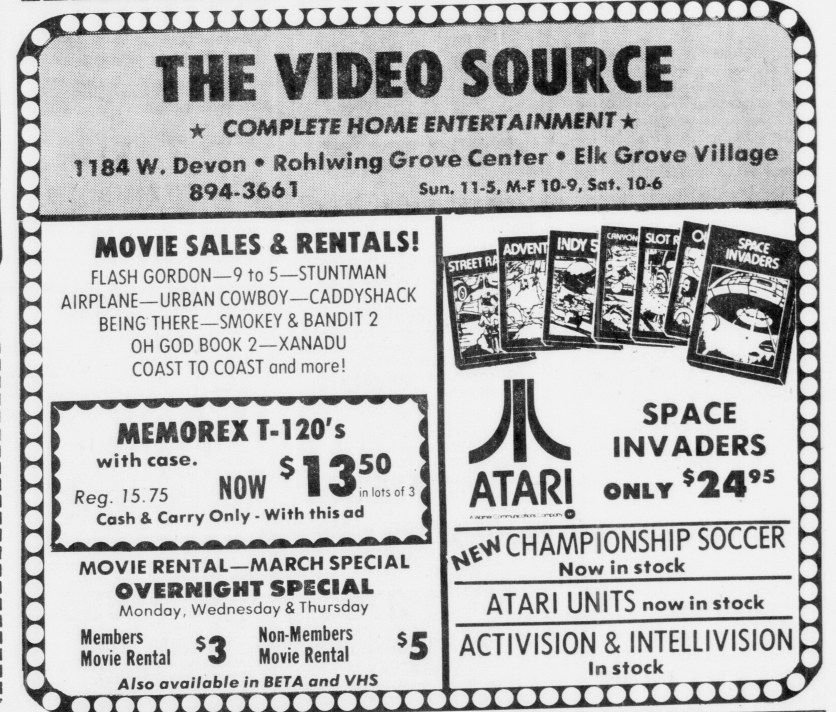
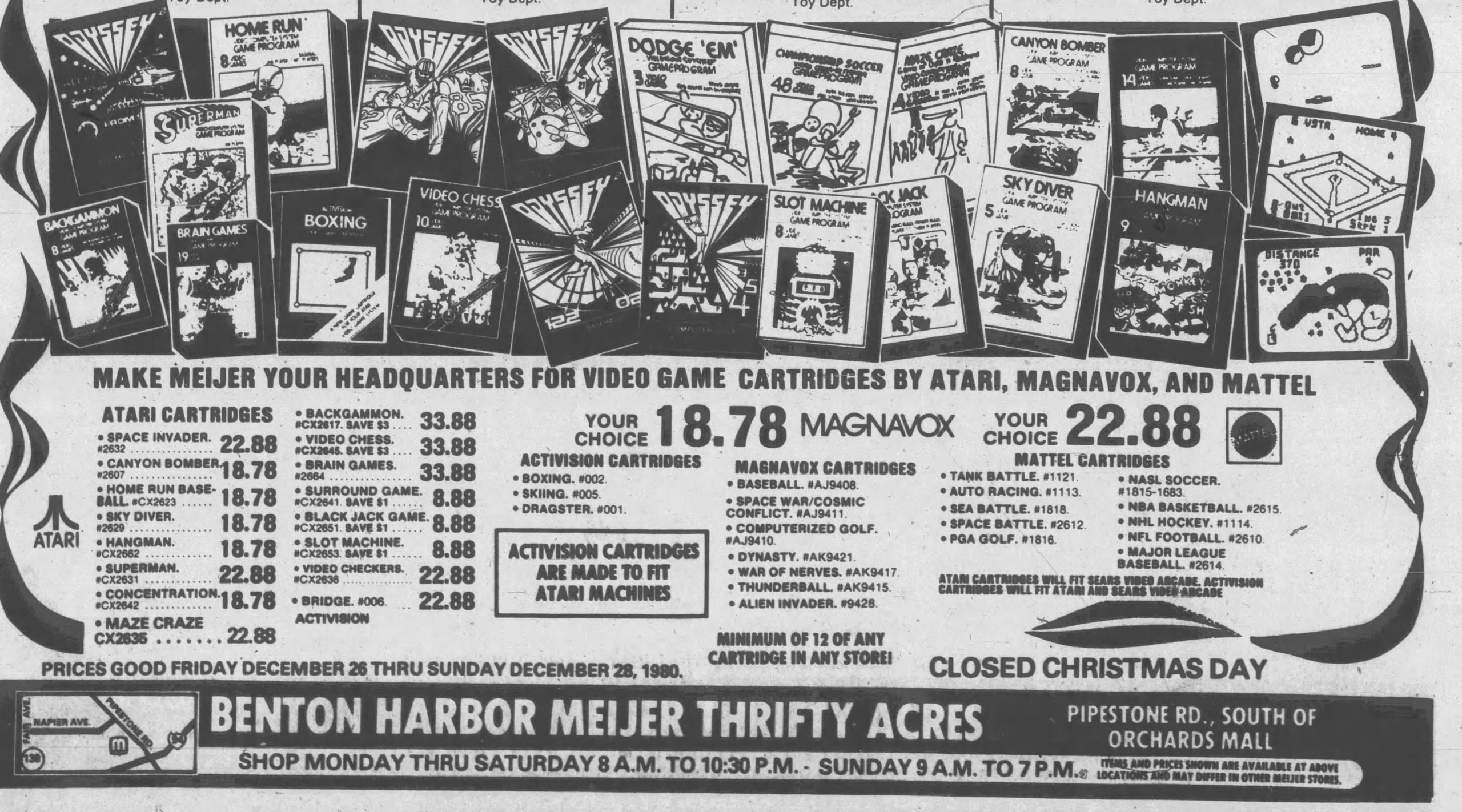
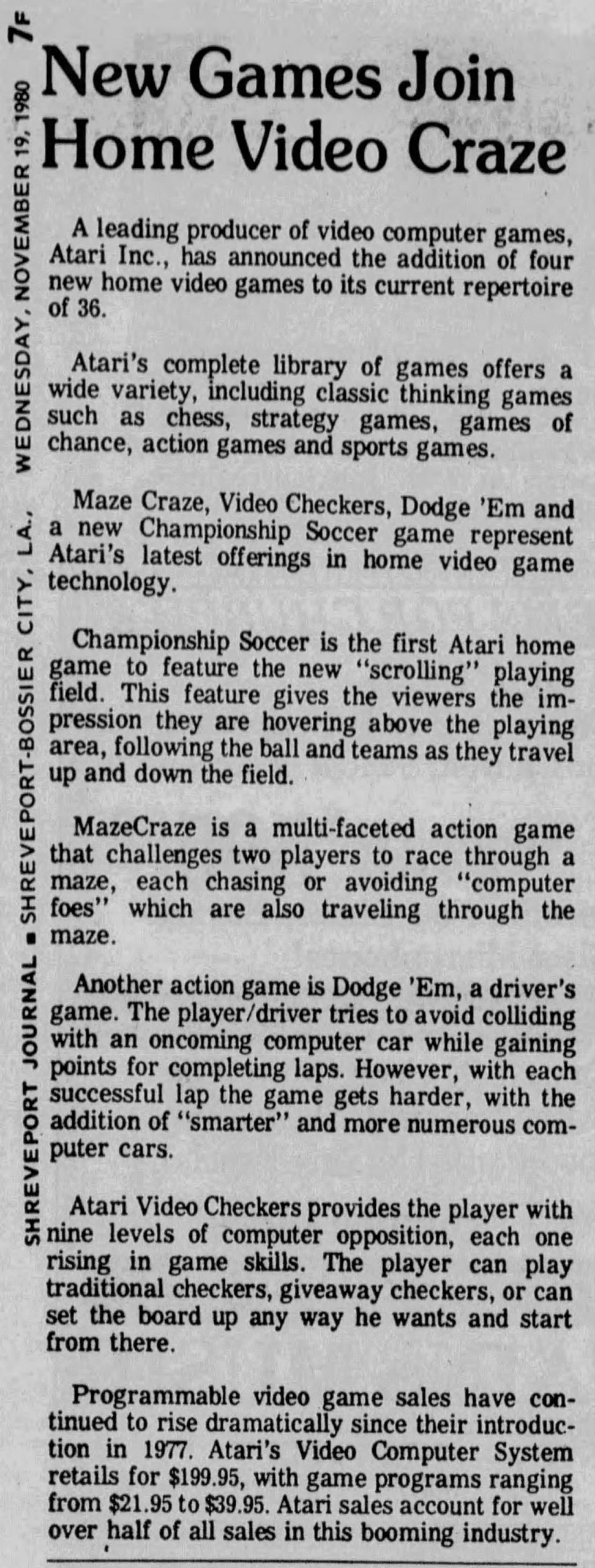
Championship Soccer (February 1981): Daily Herald Suburban Chicago, February 20 1981; Daily Herald Suburban Chicago, March 14 1981; St. Joseph Herald Palladium, December 24 1980; Shreveport Journal, November 19 1980
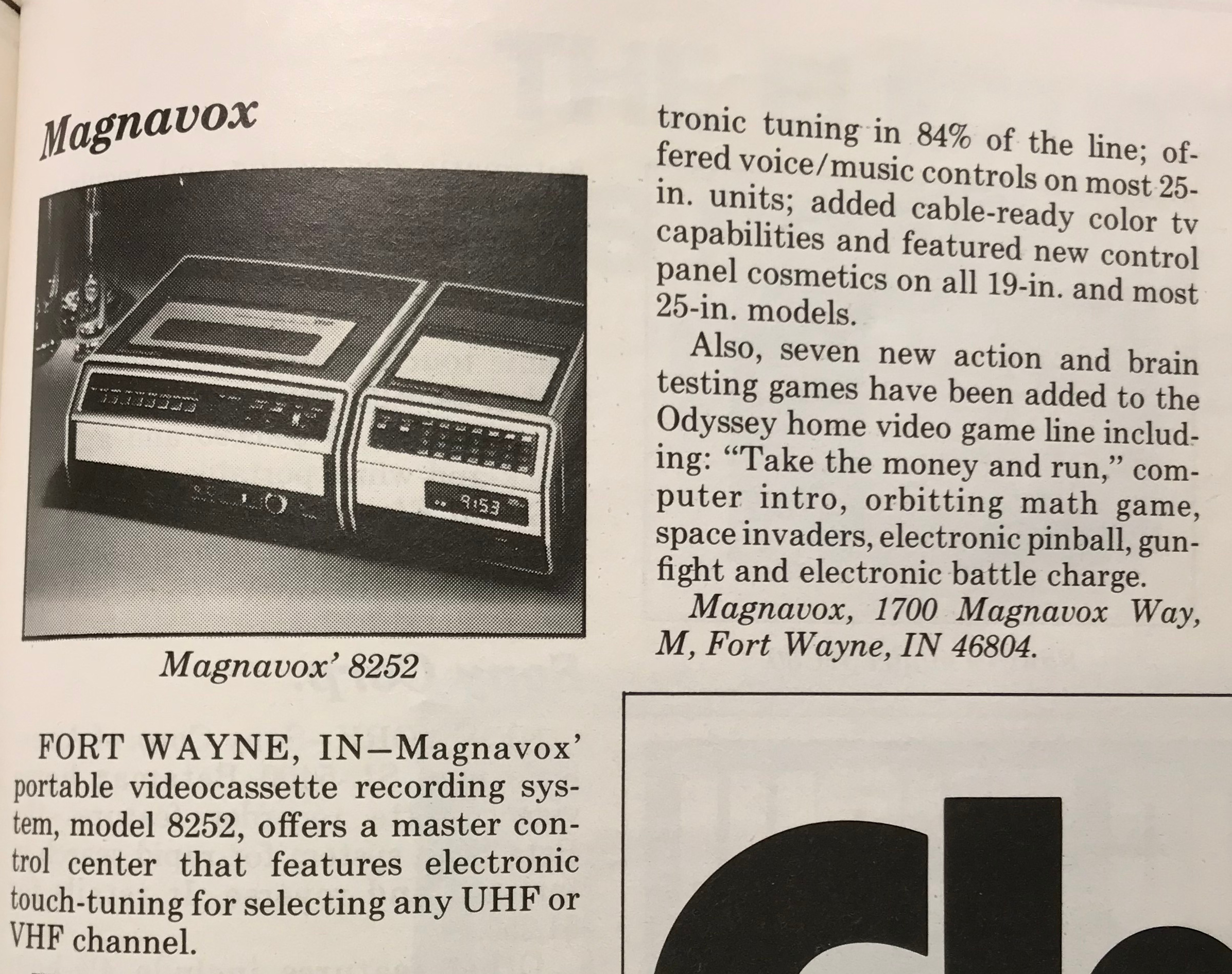
Hockey!/Soccer! (August 1979): Merchandising, June 1979; Weekly Television Digest, August 13 1979; Akron Beacon Journal, September 13 1979
Electronic Table Soccer! (August 1980): Daily Herald Suburban Chicago, August 8 1980; Santa Ana Orange County Register, October 16 1980
NASL Soccer (November 1980): Dover Times Reporter, November 27 1980; Blue Sky Rangers game list; St. Joseph Herald Palladium, December 24 1980

International Soccer (November 1982): Computer Entertainer, December 1982
Realsports Soccer (5200, November 1982): Computer Entertainer, December 1982
Realsports Soccer (2600, April 1983): Computer Entertainer, May 1983
Soccer (Bally Arcade, December 1985): Arcadian, June 1 1985; Arcadian, December 20 1985
World Cup Soccer (US, May 1986): Computer Entertainer, May 1986; Computer Entertainer, June 1986;Blue Sky Rangers game list