

When you think of video game pioneers, you most likely first think of companies like Atari, Taito, Midway, or Namco; or people such as Nolan Bushnell, Shigeru Miyamoto, or Space Invaders’ Tomohiro Nishikado. Your mind probably does not go to engineer Joe Weisbecker or his employer, the American consumer electronics behemoth RCA. And yet, through the efforts of Weisbecker and his coworkers, in the early 1970s RCA was on the bleeding edge of microprocessor, home computer and video game technology. Weisbecker’s work led to the creation of the 1801 and 1802, the world’s first microprocessors based around CMOS technology, the latter of which was used in RCA’s sole released home game console, the Studio II.
But while the 1801 was primarily utilized as a proof-of-concept to garner interest in the impending 1802, it was used for games, too: in 1975, the company location-tested a microprocessor-powered arcade video game system. According to documents held at the Hagley Museum & Library, when it was shelved, Weisbecker pivoted to using the technology for a home gaming platform. One of the prototypes built for this shift survived, and this past May, a team of preservationists were able to successfully dump the seven known carts produced for it: Bowling, Pong, Mines, Chase, Maze-Draw, Split Second, and Racing.
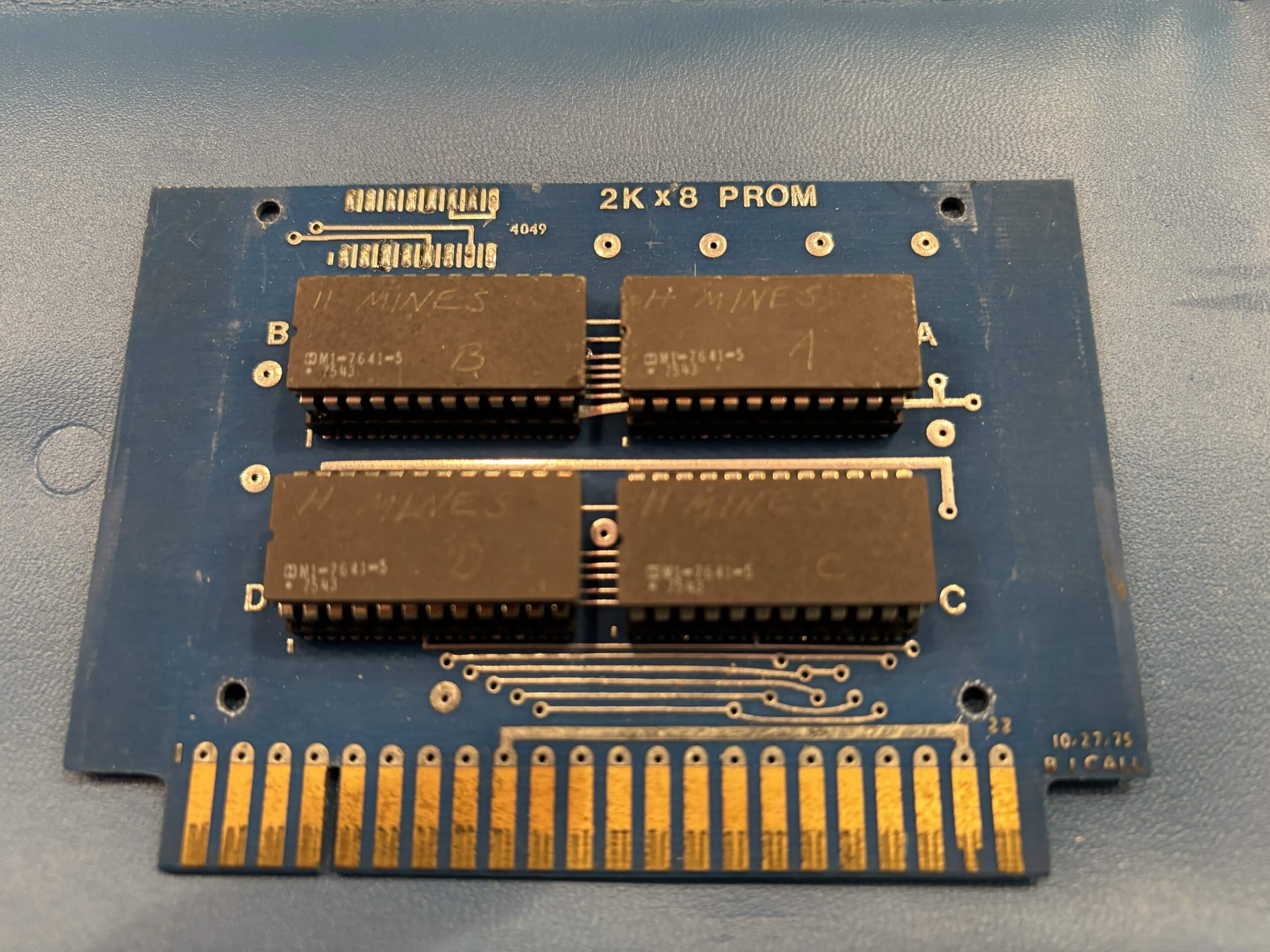
These unassuming circuit boards wrapped with protective shell pieces on either side represent the earliest known *video game cartridges* we are aware of. The circuit boards have the date October 27, 1975 etched into them, though the guts of the prototype console – which is referred to as the FRED III in the documentation with the device – appears to predate that a little. I’ll explain in a moment.
Some Background: The Friendly FRED and the Coin Arcade
It’s worth backing up for a moment to explain the origins of the FRED III and its games, because they relate to design work dating back to the mid-1950s. Weisbecker picked up an interest in computers early on from reading the book Giant Brains or Machines That Think. Frustrated that they were still too large for one to be able to buy a kit computer and make one yourself at the time, Weisbecker wound up designing himself an analog computer using pinball components that could play tic-tac-toe (which is currently housed at the Strong Museum of Play). He went onto a career working at RCA with their mainframe computer business, but this concept of smaller computers stuck with him. According to his daughter Joyce, a gaming pioneer in her own right, he recognized that components were getting smaller and cheaper, and that since one day they’d be at a point a home machine would be viable, he may as well start designing the specs he’d like to see ahead of time. Thanks to the rapid advances in transistors and integrated circuits, that time came in the late 60s, earlier than he anticipated.
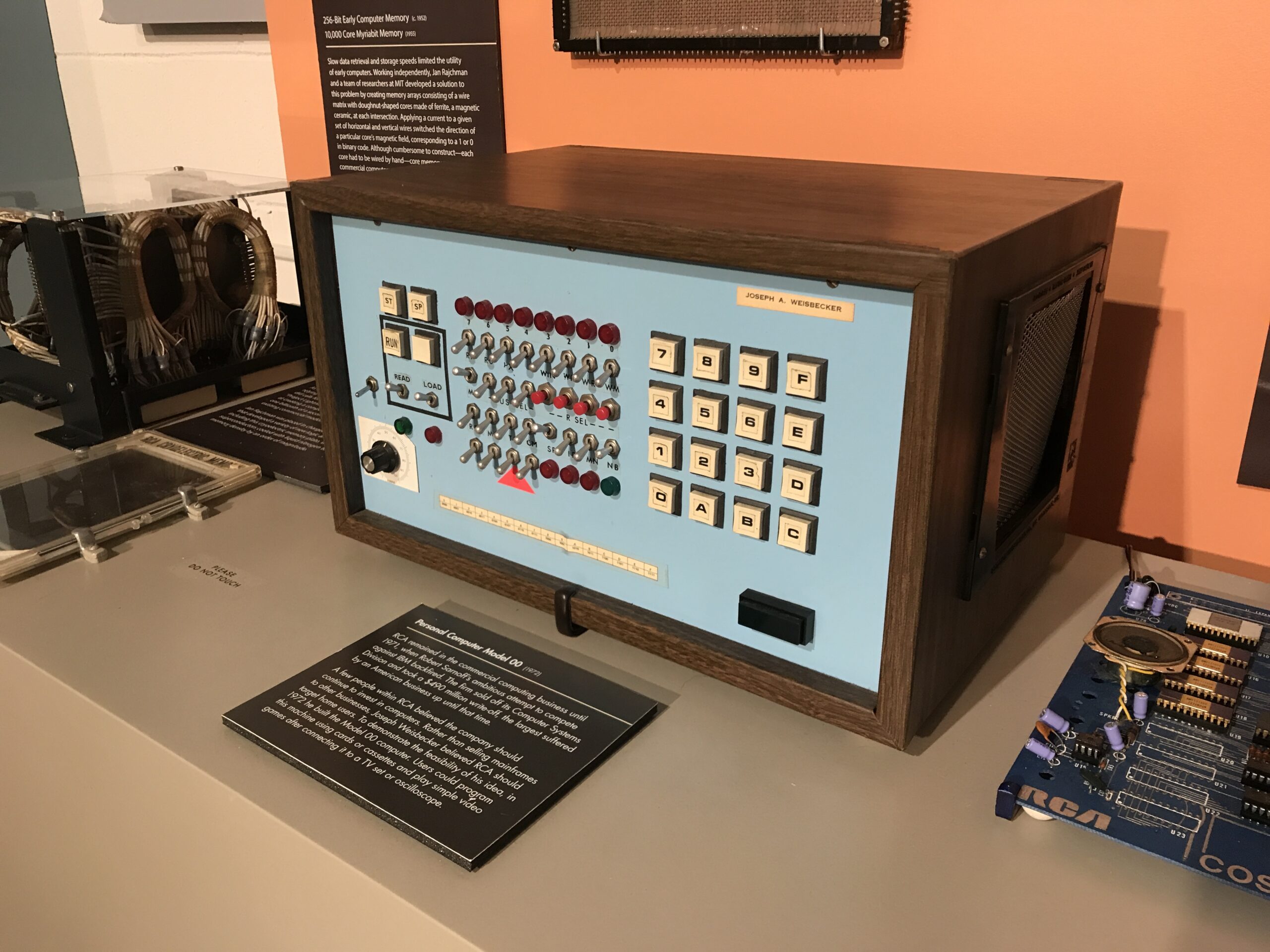
In 1968, RCA moved the bulk of its computer department from New Jersey to Marlboro, Massachusetts. Weisbecker refused to relocate, suspecting that the company was trying to make its computer division more appealing to sell to one of its rivals that were based nearby. Not long afterwards, Weisbecker had the notion that if he used the computer architecture he’d been designing as the basis for microprocessor, he’d have something he could propose to RCA as a computer project that would ideally keep him and his coworkers employed. Buying parts from the regional Radio Shack stores, he began constructing what he dubbed System 00: based on his own design, this was one of the first homemade personal computers. When RCA sold off its computer division in 1971, he was ready to pitch his computer as the basis for a microprocessor project that could be utilized in multiple types of products, and more immediately, keep his team members’ jobs; unsurprisingly, his bosses agreed.
System 00 became the basis for the FRED project – which stood for Flexible Recreational and Educational Device – and over the ensuing three years Weisbecker’s team developed and tested new hardware experiments using it, along with a slew of art and game programs. Early on Weisbecker felt that video games would be a good way of making computers approachable and fun, and he brought this ethos to FRED as one of the multiple dimensions that it could be a useful product for RCA. When FRED was miniaturized into the COSMAC 1801 microprocessor in 1974 (leading to the creation of the FRED “1.5” computer and eventually the briefcase-sized, 1802-based FRED II), Weisbecker’s team proposed using it as the heart of an arcade board, which was picked up by RCA’s Distributor & Special Products Division (DSP).
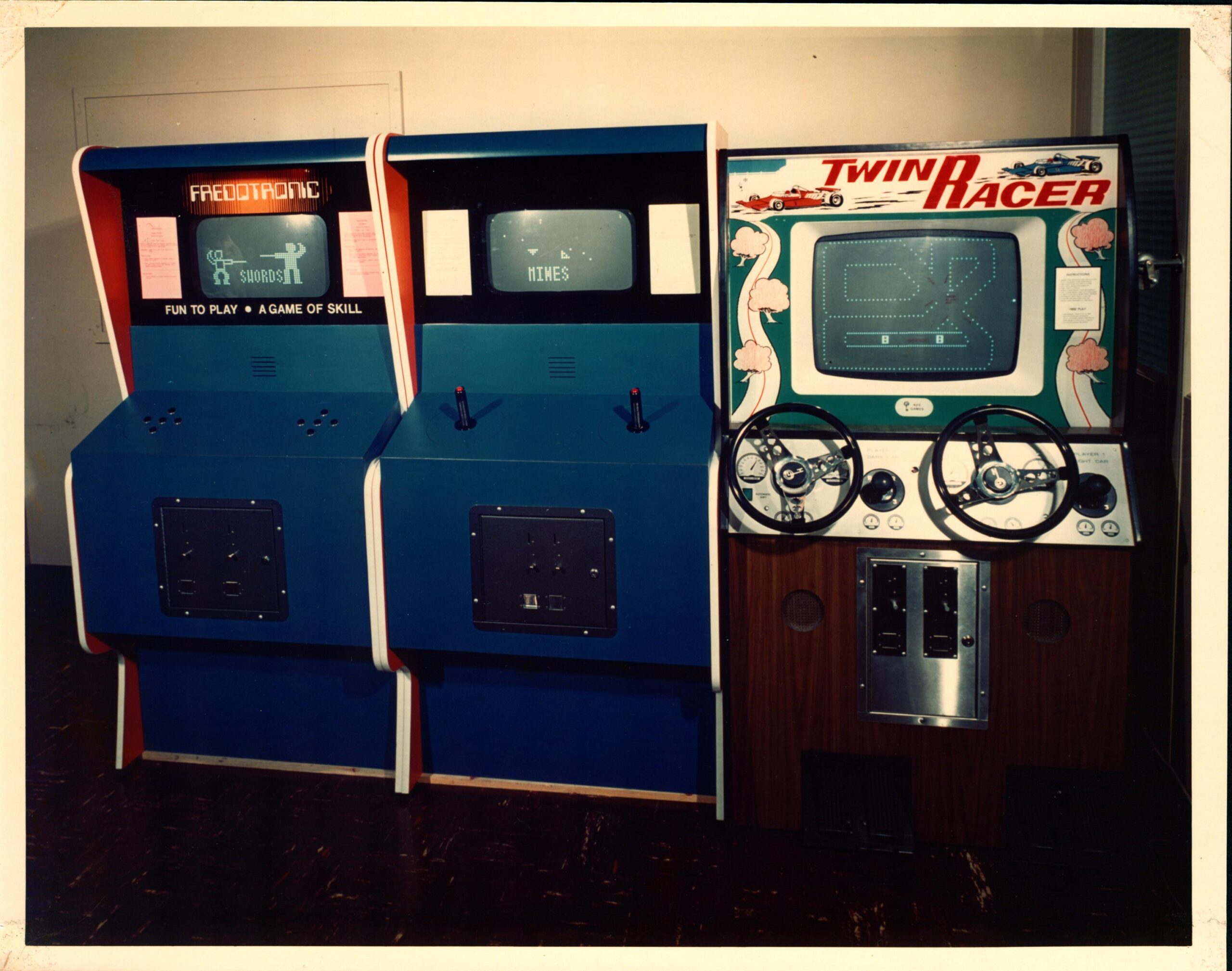
This was incredibly novel at the time. By late 1974, there had been some experiments with using microprocessors in coin-operated (primarily pinball) machines, but video games were still operating with transistor-transistor logic (TTL) circuits. It wasn’t until the fall of 1975 when the first microprocessor-based video games – Midway’s Gun Fight and Mirco’s P.T. 109 – started shipping to operators. Weisbecker and his team were entering uncharted territory, and their design diverged dramatically from what those companies were doing by utilizing plug-in game cartridges. According to surviving records, the central conceit of the Coin Arcade hardware is that the games would come on cartridges that the operator could swap out to keep things fresh. The cabinet was designed to be generic, but it could be wired up for different control schemes if the game called for, say, a lightgun. Five known Coin Arcade titles were developed and at least four of them were used in location tests around New Jersey and eastern Pennsylvania. These are Swords, a swordfighting game; Mines, an early Blockade-style game where you try to get your opponent to crash into your trail of mines; Chase, a tag game; Bowling, which is rather self-explanatory, and Scramble/Split-Second, a test of reactions. These were later preserved and reformatted into binary files off of more than 100 data tapes split between two collections held by the Hagley Museum and The College of New Jersey, along with dozens of other FRED-derived programs. For video games from 1975, they’re novel concepts and fairly interesting, and they had the added benefit of not requiring fussy, custom, TTL circuit board designs for each one.
Bringing the Arcade Home
And this brings us back to the FRED III. The arcade system reportedly had a disappointing public test (though Weisbecker’s technician Billie Joe “BJ” Call believed operators purposefully unplugged the machines because of organized crime worries), but undeterred, Weisbecker’s team considered other options. What if the arcade hardware could be used for the home? I’d like to include a quote from Call, who worked with Weisbecker and another engineer, Phil Baltzer, on this initiative at the time:
“We started doing this for gaming: recreation and education … I don’t know if there are any anywhere, but when we did the Studio II, when we had the first design of it, which was basically this box – the one that looks like the pentagonal spaceship looking thing, that box was basically Studio II. It had the plug-in cartridge, it had the keyboard – this keyboard was designed for a specific set of games … It was just four or five buttons. It had an up arrow, a down arrow, a left arrow, a right arrow, and a fire button; no more. The way this was designed was this circuitry in here was the same circuitry that we wound up with in the Studio II. This [is] an evolutionary thing. The coin-operated game – the same board that was mounted in here was mounted in the coin-operated game.” – B.J. Call, oral history with Alex Magoun, Sept. 10, 2004
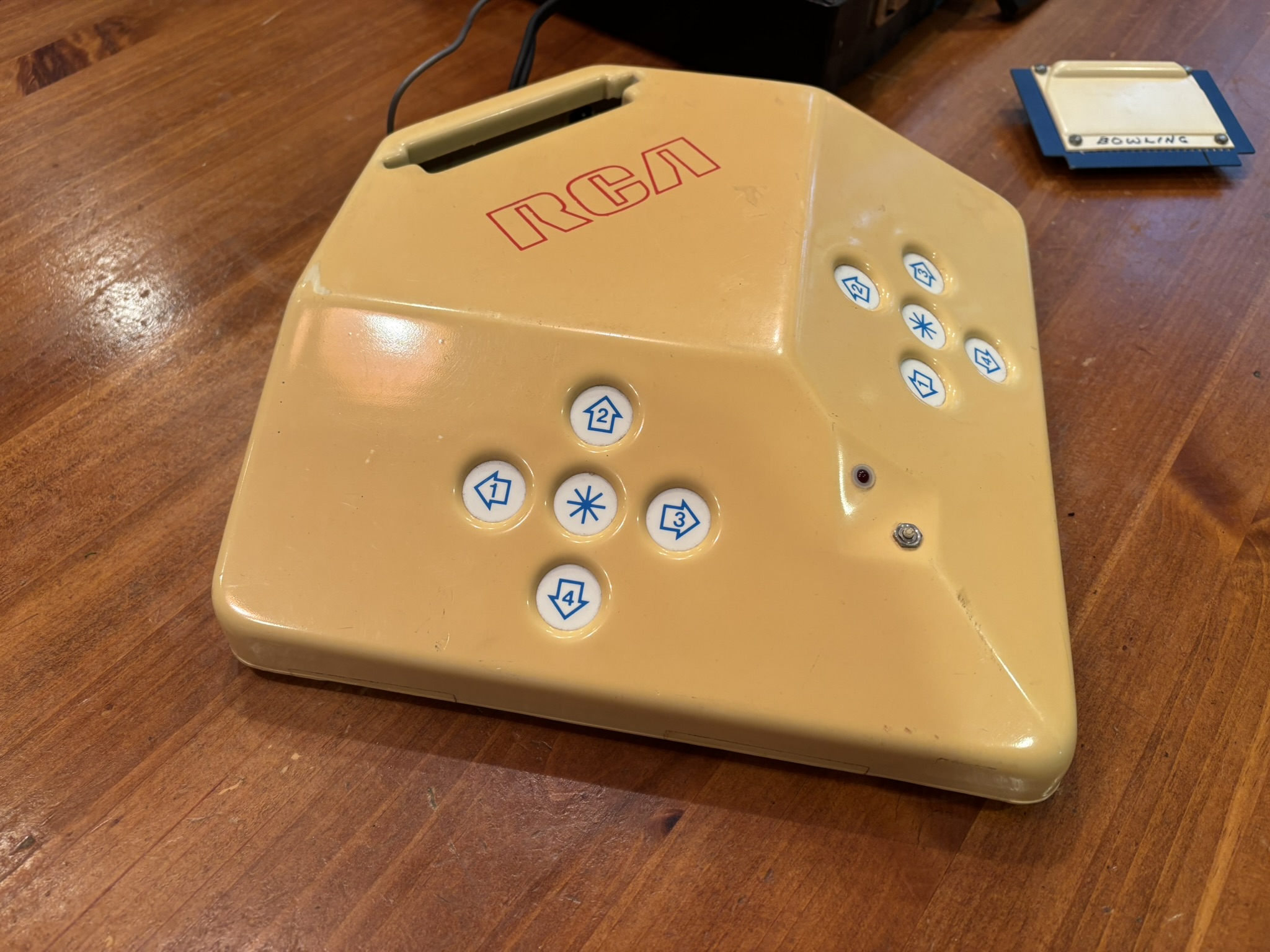
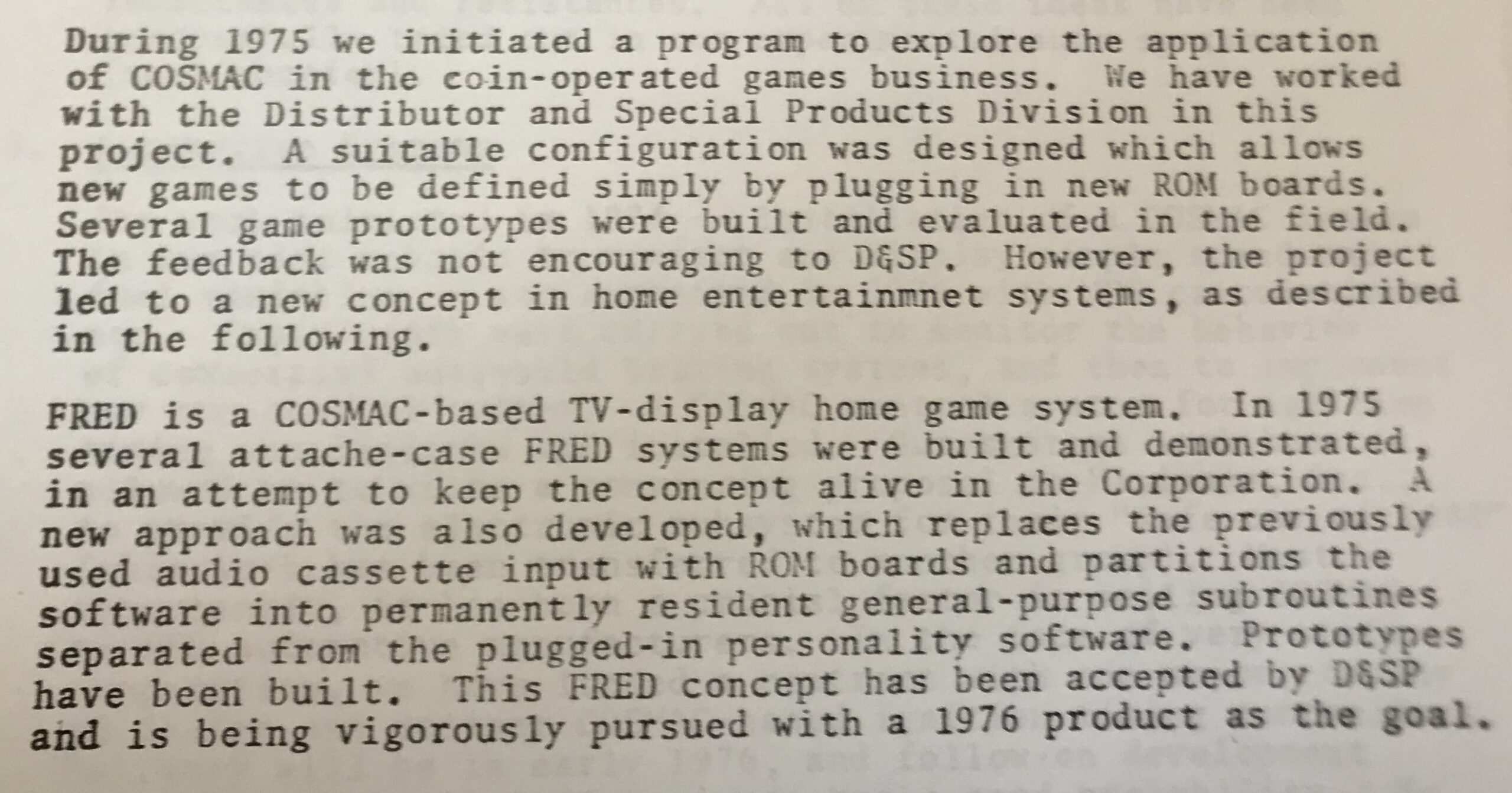
Indeed, inside of the FRED III prototype, the motherboard matches up with the diagrams of the Coin Arcade; by all rights they are nearly 1:1 save for the location of the DIP switches. The board even has “Coin Operated Game” silkscreened in a corner, indicating it was literally pulled from that machine and used here as a sort of nascent supergun. The 1975 annual report for the LSI systems design group at RCA, dated Jan. 24, 1976, talks about this new approach in more detail. Once again, RCA’s DSP division had taken on this project, highlighting the decision to keep programs on “ROM boards” akin to the arcade hardware and separates out general purpose subroutines from the bespoke game programming.
Neither the paperwork nor the console and games have any documented dates beyond the one etched into the cartridge circuit board and a mix of date codes on the chips in both the carts and console. Nevertheless, we can glean together some details to help pin it down. Joyce Weisbecker remembered the family going to see the Coin Arcade cabinets on location, telling me that the weather was fairly cool but not cold, as her mother insisted the family wear their Sunday best for the excursion but it wasn’t so chilly that they needed heavy coats. Surviving design documents are dated as being written between March and June 1975, suggesting the arcade machines were tested either in the spring or a cooler day in the fall. The date codes on the console’s chips largely indicate they were produced in June-to-November 1975. The 1975 annual report mentions the FRED III prototype, of course. Finally, a separate memo dated March 1976 indicates that the Studio II’s own final motherboard design had been pulled together at that time, so this prototype is unlikely to have been built that late. I posit that it is likely that the arcade machines were tested in late summer/early fall, with the FRED III initially built in the last few months of 1975. The carts and console likely continued to be used as testbeds after that point, as while most of the PROMs used in the cartridges have date codes lining up with the week of Oct. 20, 1975, Bowling’s PROMs are dated with the week of Feb. 9, 1976.
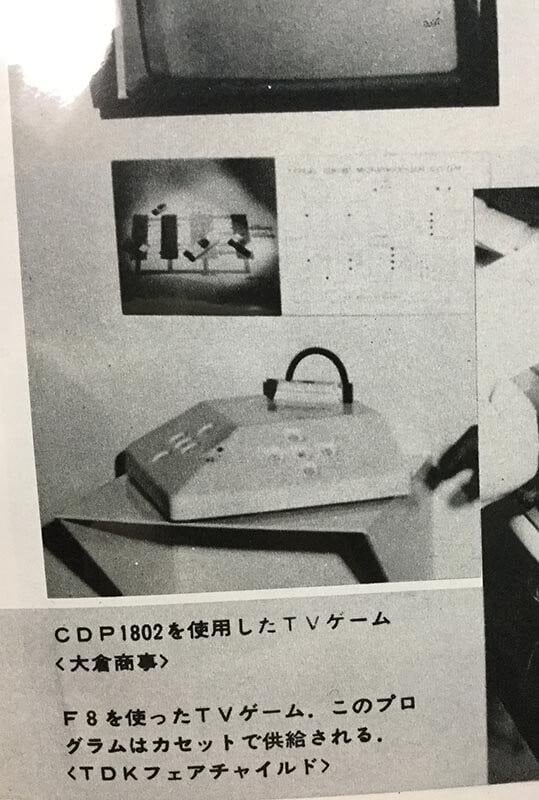
There are a few other details of how it was used, including a note about it being prepped for demonstration at the Japan Electronics Show in 1976. And indeed, in coverage from the 1976 edition of Transistor Technology Magazine, you can see the FRED III on display at the Okura Trading Company’s booth; according to the Japanese site Classic Videogame Station Odyssey, Okura Trading was the sole distributor of RCA’s products in Japan. 1
An Unlikely Survival
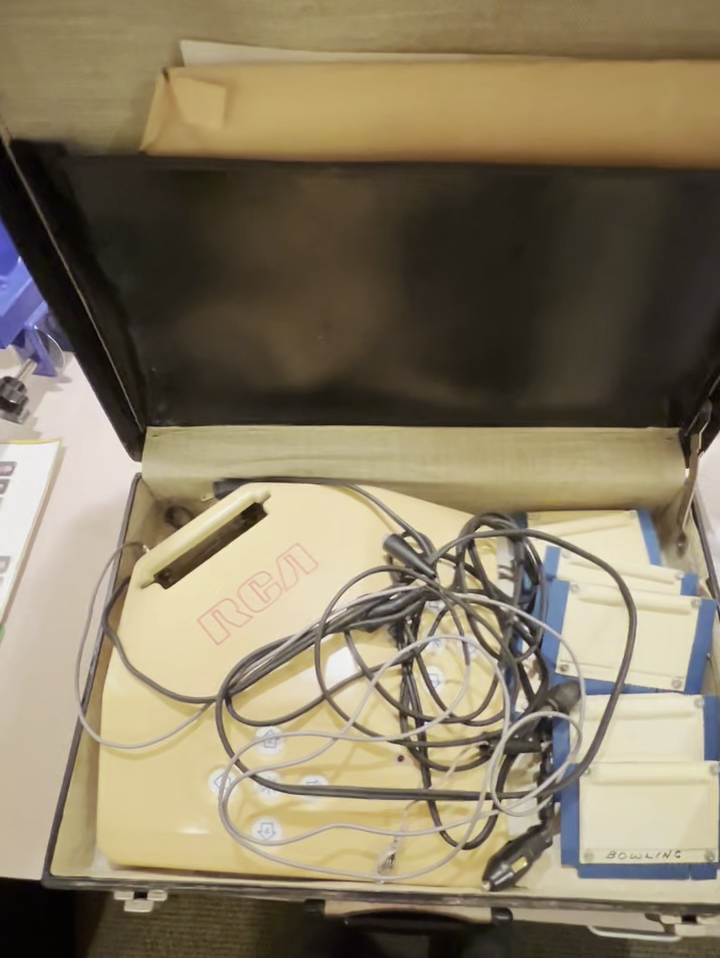
So how did this prototype come to survive all these decades? After all, neither Weisbecker nor Call had held onto any copies of the software or hardware. Instead, its survival is owed to an RCA engineer named Don Carley who, according to his descendants, had brought the machine and its games home for his kids to play once its usefulness in the lab was over. 2 Even after his kids grew up and moved on from playing with it, the FRED III remained with its cartridges and documentation in storage for the ensuing decades.
In early 2024, Carley’s granddaughter Heather reached out to the Video Game History Foundation asking for advice on identifying the system and its games, having discovered it in her grandmother’s house while cleaning. She knew it was from RCA, but could find nothing on the internet to help pin down its history. Frank Cifaldi, with her permission, then contacted me to help, and a couple months later we were able to talk about its origins, Don Carley himself, and discuss plans for preserving the contents of the briefcase the system was stored in.
The documents simply needed to be scanned, which Heather was well-equipped to do. Since the console’s motherboard matched up with that of RCA’s coin arcade schematics, emulation seemed doable on first glance. The coin arcade hardware had already been implemented in two emulators: former RCA game developer Andy Modla’s Java rendition and Marcel van Tongeren’s Emma02, which supports a wide array of 1802-derived hardware platforms. Communicating with both van Tongeren and retro computing expert Herb Johnson (both of whom had previously helped successfully digitize RCA’s archival data tapes) helped identify what images of the console’s interior would be useful for ensuring that these games could run in emulation, which the Carley family helpfully provided.
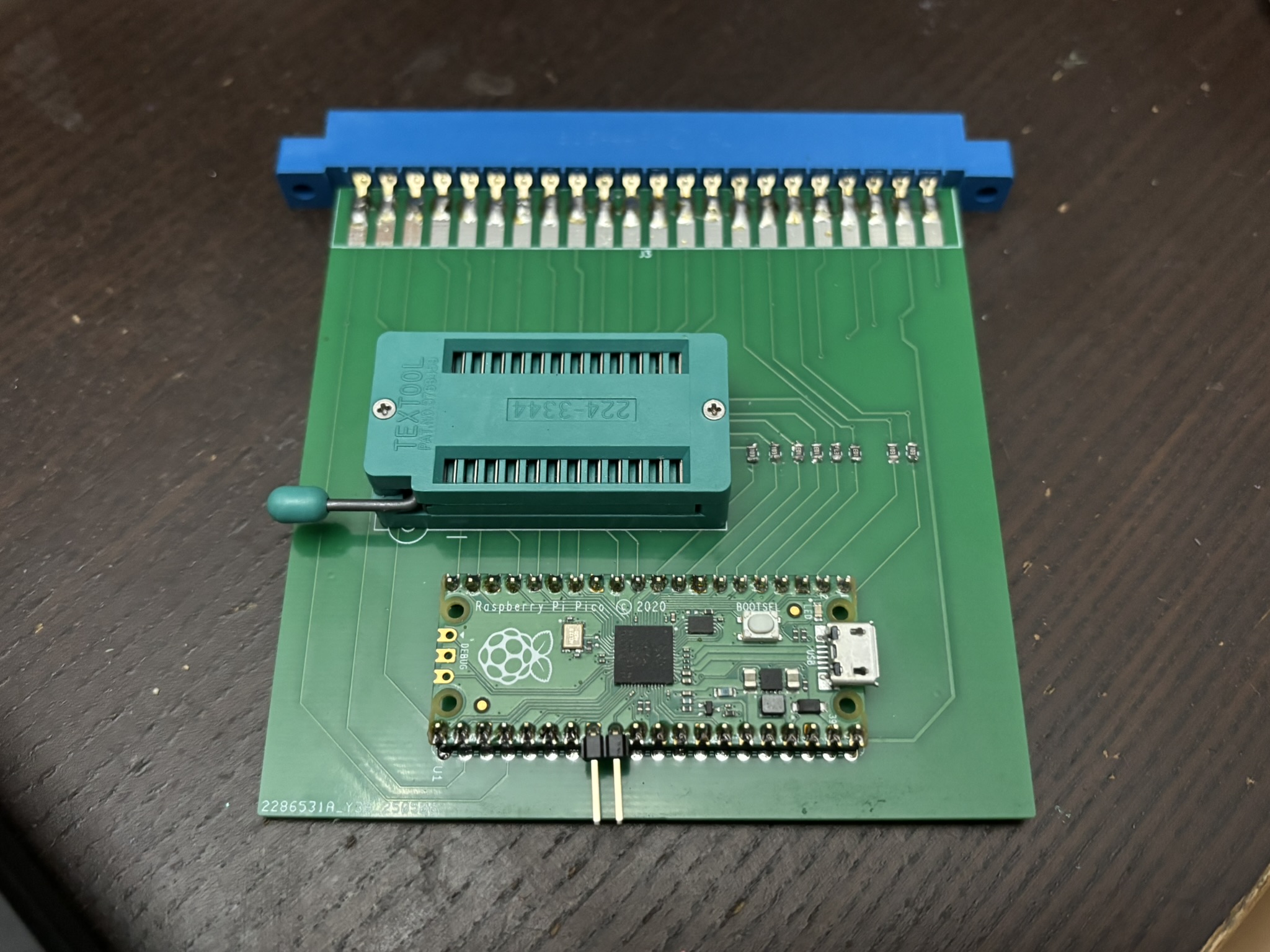
The game cartridges proved a separate sticking point, as none of the archives of RCA’s video games had anything of this nature in them. I needed a different hardware expert, and for that I turned to FLiP on the Atariage.com forums. FLiP had previously designed a custom cartridge dumper for the RCA Studio II and its clones, and was interested in the challenge of designing one for the prototype. Looking at the board photos sent by the Carleys, he quickly realized that the pins were arranged differently on the FRED III cartridges. This required some modifications to his cartridge dumper; additionally, since the PROM chips on the board were all socketed, FLiP added a chip reader to the board as well. After months of work and back-and-forth to ensure we had as much information going in as possible, it was complete and ready to ship out.
From there, it was a matter of scheduling a visit to get the data off the cartridges – a process that took some time itself. But finally, this past May, everything aligned. The cartridge reader worked as intended, successfully getting data off of each full 2k cartridge through its pin connector and the individual 512-byte PROMs. Through this process I was in touch with both FLiP and van Tongeren to help with any troubleshooting and to inspect the data coming in. The data was not laid out the way either man anticipated, which took van Tongeren some effort to arrange properly, but in the end, we were able to successfully get the full data off of all seven cartridges. The documentation scans and the game binaries are linked on this post, and they should all run properly in emulation.
The data secure, Heather is in discussions to donate the physical hardware itself to a museum for long-term preservation, and to help tell the story of RCA and video gaming.
What does the rediscovery of the FRED III tell us?
The existence of RCA’s Coin Arcade and now the FRED III provide a wrinkle to the more widely known story of how the video game cartridge format was developed. As reported by Benj Edwards in 2015, Fairchild’s engineer Ron Smith and designer Nick Talesfore designed the cartridge used for the Channel F, the first programmable game system to reach stores; Atari later hired Smith’s contracted engineer assistant, Doug Hardy, to design the cartridge used on the VCS/2600.
The effort at RCA is an example of parallel evolution in technology, as it was completely separate from Fairchild and Atari’s work on the West Coast. At RCA, William Bachman of the DSP was tasked with making these prototype carts into something hardy enough for consumer use. In a 2014 interview with Edwards, Bachman explained that the prototype carts were prone to damage from electrostatic discharge, which they were warned about. Bachman resolved this with antistatic grounding mechanisms built into both the cart and the console, which protect the chips inside; the circuit board and these mechanisms are secured within a full shell, unlike the basic pieces of plastic seen on the FRED III. But it doesn’t appear Bachman was necessarily involved with the coin arcade or FRED III themselves, remarking to Edwards that the staff working on the video game project at the Sarnoff Labs had already come up with the cartridge concept but needed their expertise to actually design it into a product. Neither Weisbecker or Call, had contemporary companies to look to for guidance in 1975 and likely landed on a cartridge over a data cassette or other loading mechanism for the same reasons other companies did: no moving parts, minimal wear-and-tear, and simple enough for an operator to swap in and out; Bachman for his part noted that they had no awareness of what was happening at Fairchild.
We also see an early effort to design programmable games specifically for the home. Four of them are slightly modified versions of Coin Arcade titles: Bowling, Mines, Split-Second and Chase, designated on their labels as “home” versions. According to van Tongeren, the only real difference in the code between these carts and the ROMs pulled off of the archived data tapes is that the routines were modified to skip looking for a coin and to end after a set amount of time; while Bowling always had you playing a full 10 frames, Mines, Split Second and Chase now all will end after a player scores 50 points instead of only after two minutes. Mines also has instructions for utilizing the DIP switches on the underside of the prototype console to adjust the game speed. These are fairly minor adjustments, but show a consideration on how to adjust the play experience for an environment where players aren’t being rushed to put in another quarter. The documentation explains how these games work rather succinctly.
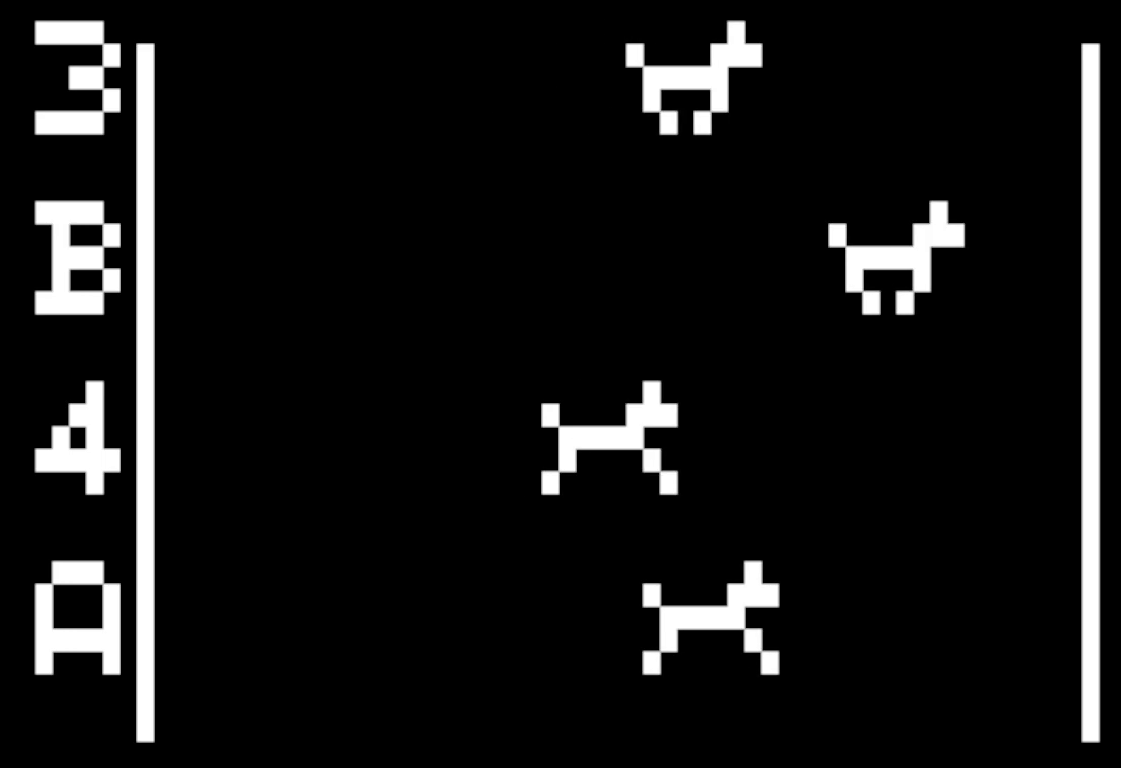
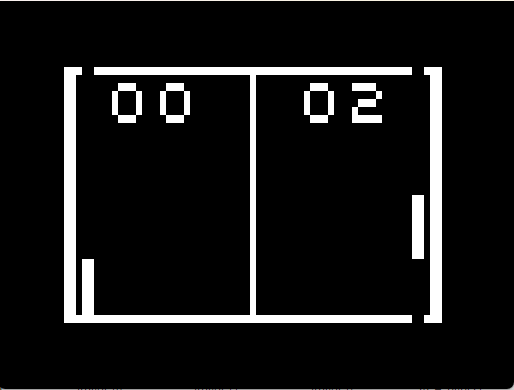
The other three carts: Pong, Maze-Draw, and Racing, all appear to have been made specifically as home games, and show in their design. Pong is a conversion of Atari’s arcade game, with ball speed controlled by the DIP switches (it’s also the only one with no instructions in the documentation). The first player to 21 points wins in this version, and unusually the player serving the ball swaps after every five serves regardless of who scores. At the time the only such home Pong games that existed on the market were Atari’s own game, similar ones on Magnavox’s Odyssey line, and some obscure devices like the Video Action that appear to have been repurposed arcade hardware, so an all-microprocessor Pong title is rather novel. Racing (or Home Down on the label) is actually a gambling game where you bet on the outcomes of horse races, which may not be particularly exciting in 2026, but was a fairly common computer game concept in the late ’60s and 1970s. It features a cute little animation of the horses running after you’ve placed your bets, but there’s not really much else interactive happening. 3
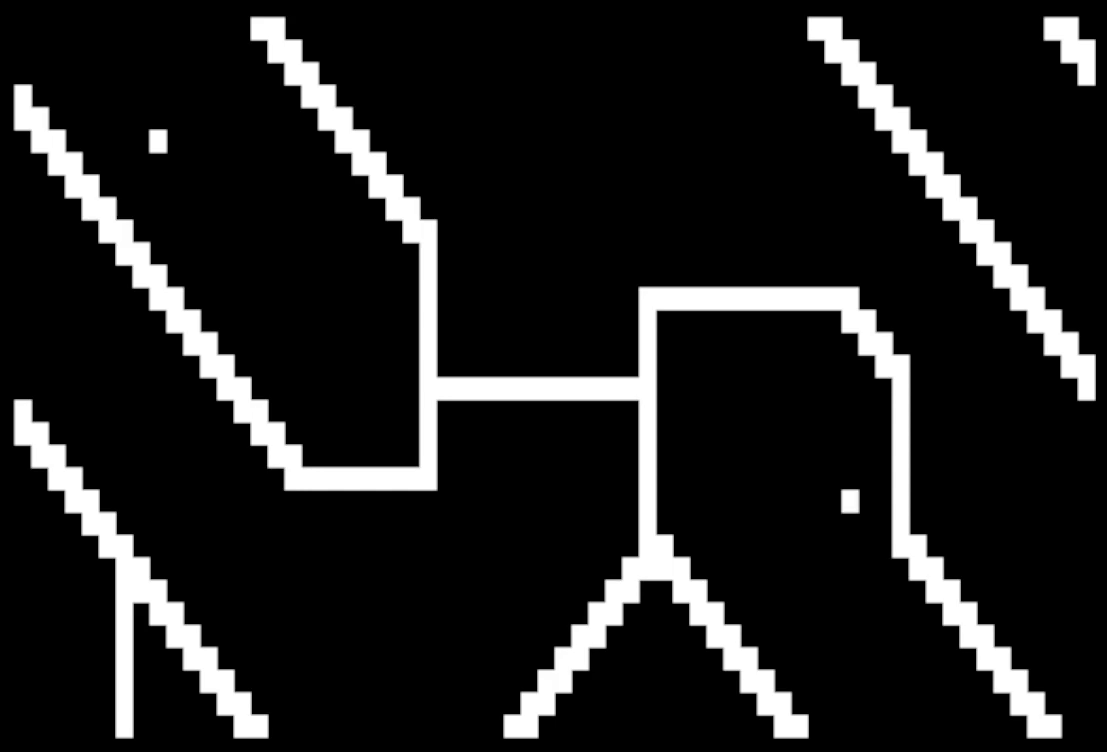
Maze-Draw is a rather neat concept, though – by holding the * buttons down when resetting the game, it will load a premade maze for you to navigate through, which was also a fairly common computer gaming experience. Pressing the * button while the game is active will cause your target spot to flash; pressing it again once you’ve reached that point will win the game. The “draw” portion of the program allowed you to not only draw pictures on screen, but to also create maze walls as you see fit to then navigate in maze mode. This is the sort of gaming experience you really could not find in arcades in 1975, and is a well-considered effort on the part of the FRED III staff. 4
The FRED III was first built and operated at a point in time where hardware designers were still trying to figure out what microprocessors could mean for a home video game system. Beyond that, it was being tested when even the general concept of a home video game console was defined almost exclusively by the Magnavox Odyssey. The staff that made it had experience from their work with FRED and Weisbecker’s own interest in a home computer that could play games, but turning a machine with multiple switches and a hex keypad into a plug-and-play console? That took a lot of thought and time to work out.
If you’d like to try the games out, you can find them and the documentation posted on the Internet Archive here. Both Emma02 and Modla’s Java emulator should be able to run them. Temper your expectations for the time period they were made, and you should be able to appreciate what was the bleeding edge of video game technology they represented in 1975, and their improbable survival to 2026.
Special thanks to Herb Johnson, Andy Modla, Marcel van Tongeren, FLiP, Florencia Pierri, Heather Carley and the rest of the Carley family for making this possible – this was a team effort. And additional thanks to the Hagley Museum & Library and the College of New Jersey for their archival materials, for previous historic research and interviews done by Benj Edwards and Alex Magoun, and to Joyce Weisbecker, Toni Robbi, Paul Russo, C.T. Wu, and Bob Winder for speaking with me their involvement with the early FRED machines.
Sources:
RCA Engineer, 1965-1979, worldradiohistory.com
Andy Modla, oral history with myself, June 18, 2021
Joyce Weisbecker, oral history with myself, June 17, 2021
Heather Carley, correspondence with myself, Feb-May 2024
Classic Videogame Odyssey Station
Transistor Technology Magazine, December 1976
The Joseph Weisbecker Papers and the B.J. Call Papers, Hagley Museum & Library
RCA Coin Arcade schematics, Weisbecker’s photos of his FRED projects and colleagues, data tapes, and the Annual Report for the LSI Systems Design Group for 1975, Bob Winder, Jan. 24 1976
The Sarnoff Collection, The College of New Jersey
Data tapes, access to photograph FRED-related artifacts, and providing a recording of an oral history with B.J. Call with Alex Magoun, recorded Sept. 10 2004
- There has been much speculation why the Japanese Studio II clone, the Visicom COM-100, is not entirely compatible with the Studio II or the Studio III clones and has unique games; my speculation is that someone from Toshiba saw the FRED III, liked it, and effectively licensed out the Studio II as a fork based off of this appearance.[↩]
- Carley was associated with the FRED project and finding commercial and industrial use cases for the 1802, notably on an arrangement to use the chip to control vehicle emissions. He also was the one who appears to have brought the machine to demonstrate at the Japan Electronics Show in 1976, based on the documentation that was found with the system.[↩]
- Van Tongeren also found that Racing and Pong use a modified language interpreter than the other games that reassigns 5 opcodes; there is no indication as to why.[↩]
- There are no indications who wrote these games, though it is likely that Weisbecker authored at least some of them; Joyce believes her father seemed to have developed the arcade titles as he once explained to her that his ending tune on the game over screen was a reference to the song After You’ve Gone, albeit barely recognizable with the primitive sound capabilities of the hardware.[↩]